What if the world's largest particle detector wasn't built in a laboratory, but frozen into the surface of a continent?
NASA's PUEO mission (the Payload for Ultrahigh Energy Observations) turns Antarctica itself into an instrument. Part of the agency's Astrophysics Pioneers Program, PUEO is designed to detect ultrahigh-energy neutrinos — elusive cosmic messengers produced by the most extreme events in the universe.[i]
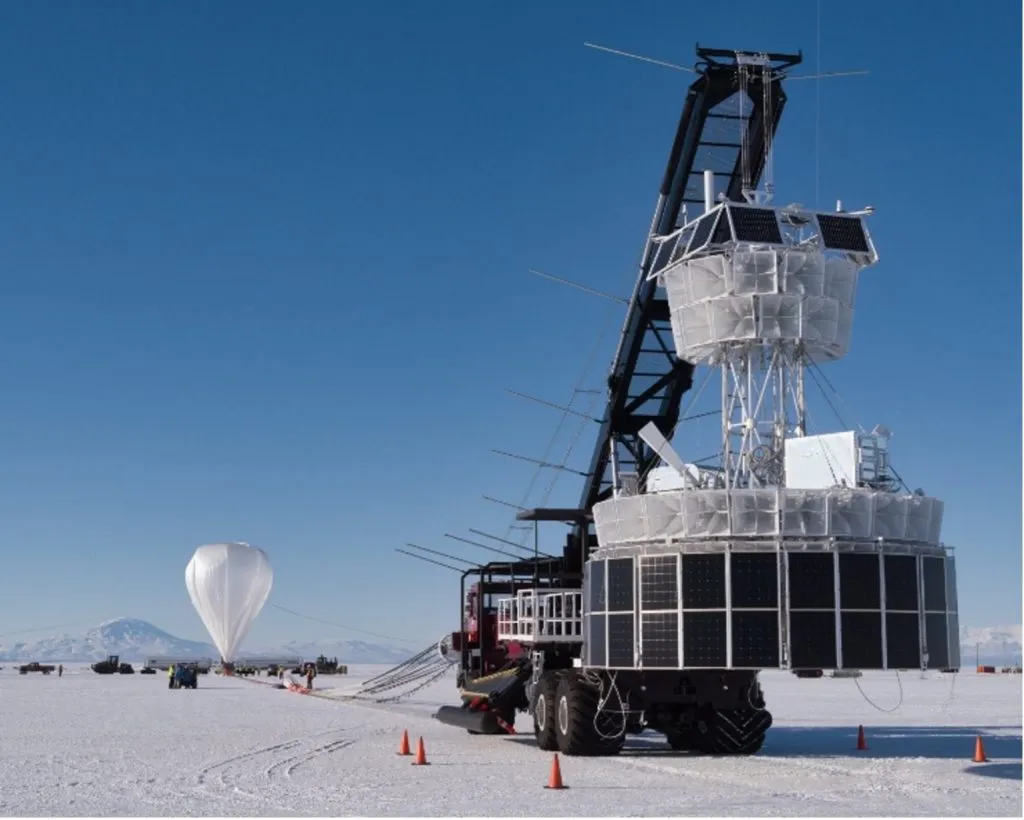
When one of these rare particles interacts with Antarctic ice, it emits a faint radio pulse — a whisper of energy traveling upward through kilometers of frozen silence. From roughly 35 kilometers above Earth, suspended beneath a NASA long-duration scientific balloon launched from McMurdo Station, Antarctica PUEO listens for those whispers.[ii]
It is a recoverable, cost-disciplined alternative to orbital observatories — but no less ambitious in what it seeks to understand.
The 2025-2026 Antarctic Campaign
PUEO's most recent Antarctic flight occurred as part of NASA's long-duration balloon campaign from December 20, 2025, launching from the Ross Ice Shelf near McMurdo Station. [iii] The scientific balloon carrying the Payload for Ultrahigh Energy Observations ascended to roughly 120,000 feet (≈36.6 km) and drifted on stratospheric winds over Antarctica. [iv]
After approximately 23 days aloft, scanning the continent for ultrahigh-energy neutrino signals, the balloon mission concluded with a safe landing in early January 2026. [v] Scientists from the University of Chicago and collaborating institutions have since begun post-flight data analysis to search for the faint radio pulses generated when neutrinos interact with ice — data that could illuminate some of the highest-energy processes in the universe. [vi]
This campaign marked a milestone for the Astrophysics Pioneers Program: it was NASA's first balloon mission under that program and demonstrated improved onboard detection capabilities compared with earlier Antarctic neutrino experiments. [vii]
The Engineering Reality: Computing Without Air
At float altitude, there is almost no atmosphere — and therefore no convective cooling.
At approximately 35 km, ambient pressure drops to a small fraction of sea-level conditions (https://www.nasa.gov/scientificballoons/balloon-technology/), meaning electronics must rely on conduction and radiation for thermal management rather than airflow. [viii]
For PUEO's flight computer and GPU processing system, this required:
- Careful thermal path design from processor to structure
- Custom heatsink development, ideally modeled in 3D CAD
- Ruggedized embedded systems suited to low-pressure operation
- Early planning around extended hardware lead times
The GPU in this configuration is used strictly for onboard signal processing — high-density parallel computation without external I/O demands. Form factor flexibility (XMC or MXM, with XMC preferred) allows integration within compact, conduction-cooled embedded architectures.
In this environment, performance is not measured in peak benchmarks, but in sustained, predictable operation under constraint.
WOLF's Contribution
WOLF supported the PUEO effort with embedded compute platforms, including the 3176, 3476, and 3170 boards, enabling high-throughput signal processing and flight computer development.
Balloon missions often progress through staged hardware integration — from development systems to thermal validation to flight-ready configurations. Given the need for interim GPU solutions while final hardware is completed, WOLF's platforms supported evaluation, integration, and processing development phases critical to mission readiness.
In stratospheric missions like PUEO, compute hardware is not auxiliary. It determines how effectively rare neutrino signatures can be isolated from background noise — and ultimately, how much science can be extracted from weeks at altitude.
Why It Matters
NASA's scientific balloon program occupies a strategic space between ground-based observatories and orbital platforms. [ix]
It offers:
- Near-space access at a fraction of orbital cost
- Recoverable payloads for refinement and iteration
- Rapid development cycles compared to satellite missions
But it demands disciplined engineering.
PUEO represents that balance: ambitious astrophysics supported by precise thermal design, embedded computing, and systems built to operate where air no longer helps you.
And from that thin edge of atmosphere, we learn something about the most energetic phenomena in the universe.
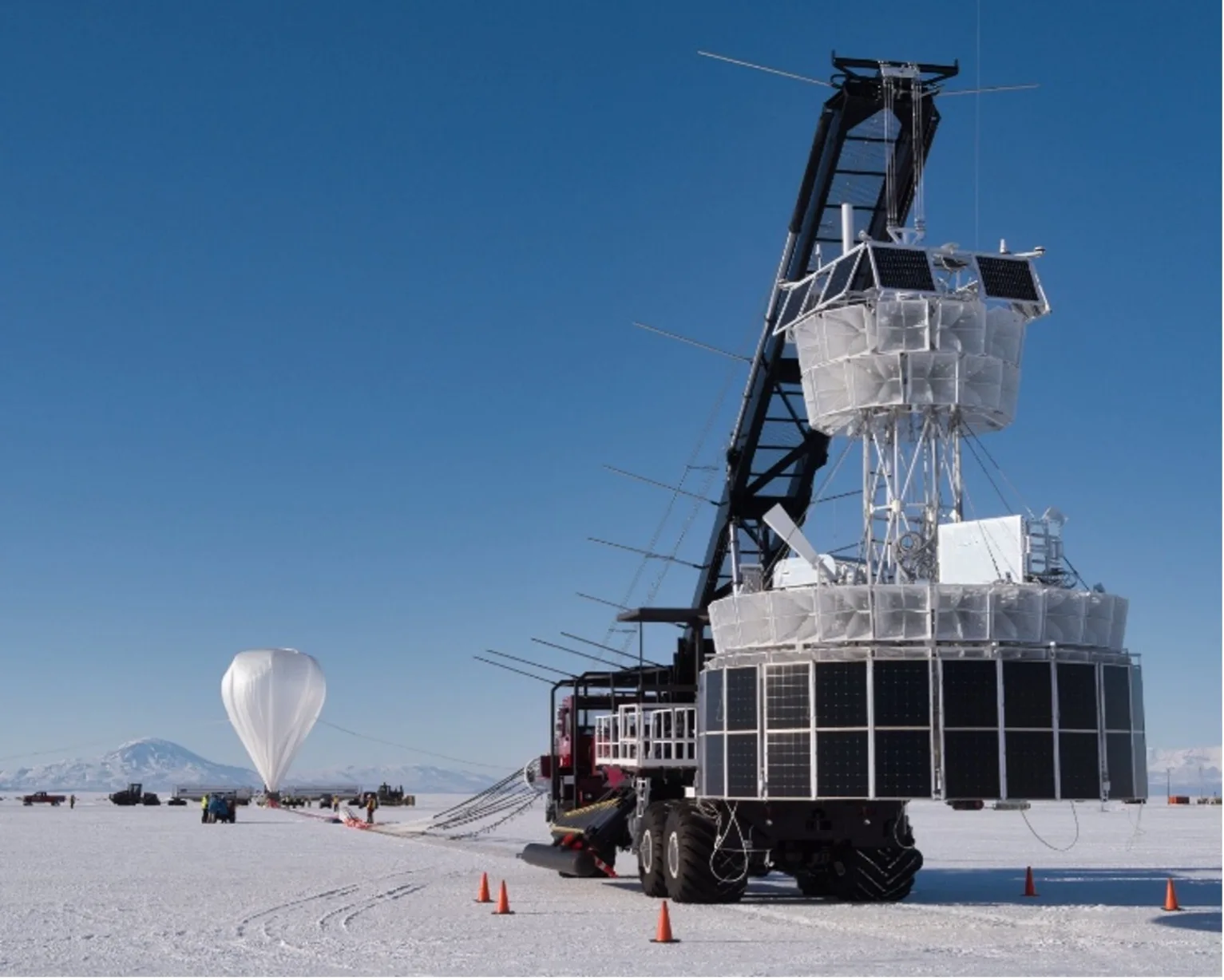
Image I. The PUEO balloon at McMurdo Station off the Ross Ice Shelf in Antarctica. December 2025. (Image credit: NASA Scientific Balloon Program)
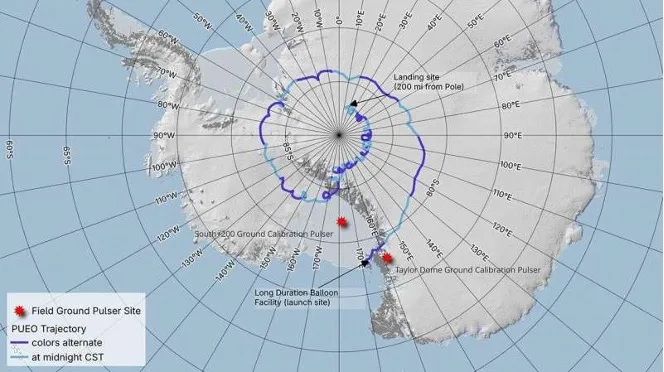
Image II. Recreation that shows the flight path of PUEO. For 23 days, PUEO circled Antarctica before landing on the South Pole. (Image credit: NASA Scientific Balloon Program)

Image III. The PUEO project shares its name with the pueo owl (Asio flammeus), the only owl indigenous to Hawaii. The owl symbolizes intelligence and awareness, characteristics fitting for a mission designed to detect the universe's faintest signals.
About Wolf Advanced Technology
Wolf Advanced Technology (WOLF) delivers rugged, high-performance embedded computing, AI, and video processing solutions for aerospace and defense. Leveraging NVIDIA® GPUs and AMD®/Xilinx® FPGAs, WOLF delivers SWaP-optimized SOSA® aligned VPX, XMC, MXM/MXC, VNX+, SFF, and custom solutions, enabling real-time video, AI inference, and high-speed data in mission-critical environments.
[i] NASA, “Astrophysics Pioneers Program,” NASA Science, accessed March 3, 2026, https://science.nasa.gov/astrophysics/programs/astrophysics-pioneers/.
[ii] NASA, “Scientific Balloon Program,” NASA Wallops Flight Facility, accessed March 3, 2026, https://www.nasa.gov/scientificballoons/
[iii] NASA, “Second Scientific Balloon for NASA Launches from Antarctica,” NASA Wallops Flight Facility Blog, December 19, 2025, https://www.nasa.gov/blogs/wallops/2025/12/19/second-scientific-balloon-for-nasa-launches-from-antarctica/
[iv] “In Antarctica, Balloon Lands after 23-Day Search for Particles from Outer Space,” Phys.org, February 6, 2026, https://phys.org/news/2026-02-antarctica-balloon-day-particles-outer.html.
[v] Ibid.
[vi] Ibid.
[vii] Clarence Oxford, “NASA Prepares Long Duration Antarctic Balloon Campaign to Probe Neutrinos and Dark Matter,” SpaceDaily, December 5, 2025, https://www.spacedaily.com/reports/NASA_prepares_long_duration_Antarctic_balloon_campaign_to_probe_neutrinos_and_dark_matter_999.html
[viii] NASA, “Balloon Technology,” NASA Scientific Balloon Program, accessed March 3, 2026, https://www.nasa.gov/scientificballoons/balloon-technology/
[ix] NASA, “Scientific Balloon Program Overview,” NASA, accessed March 3, 2026, https://www.nasa.gov/scientificballoons/