WOLF-N4XP
Block Diagram
The block diagram shows the NVIDIA Jetson Orin NX 16GB connected to 1TB NVMe storage and the VNX+ rear connector. It identifies PCIe Gen4 x4 and x1 interfaces, DisplayPort or HDMI output, MIPI CSI-2, 1000BASE-T Ethernet, USB, SPI, UART, I²C, audio, IPMI system management, and forced-recovery and system-reset connections.
Overview
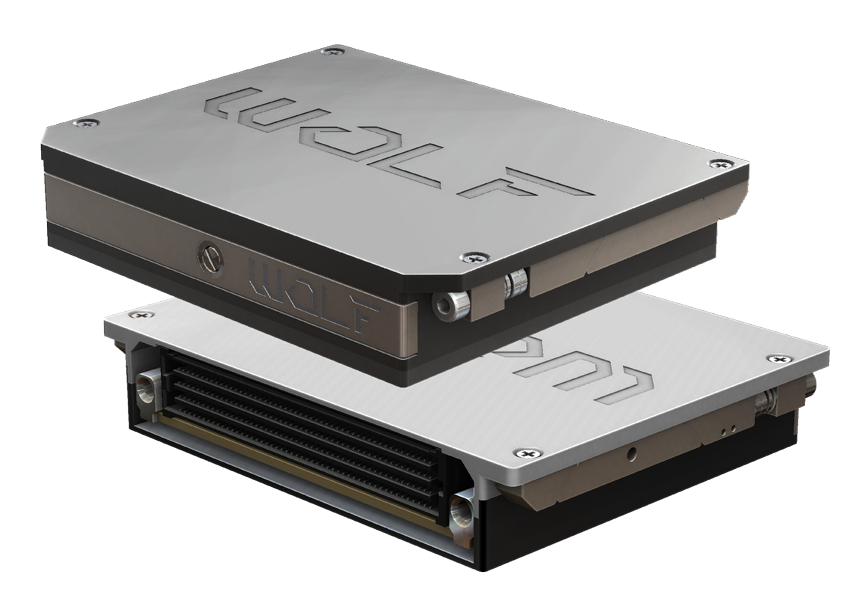
Secure AI and HPC Node with NVIDIA Jetson Orin NX
The VNXP-ORIN-NX is an autonomous, secure compute node which provides advanced AI and HPC processing capabilities, PCIe Gen4, network data transfer, and cyber security features to ensure data is being protected. The small VNX+ form factor allows the technology to be deployed into extremely small spaces.
The NVIDIA Jetson Orin NX includes an embedded Ampere GPU which provides the CUDA cores and Tensor cores for data processing, deep learning inference, machine vision, audio processing and video encoding/decoding. The 1024 CUDA cores run at up to 918MHz providing GPGPU processing, while the 32 Gen3 Tensor cores provide the underlying architecture required for an efficient inference engine which can achieve up to 100 TOPS (INT8, Sparse) of deep learning inference computing.
The integrated NVMe SED (Self Encrypting Drive) supports data encryption providing protection for sensitive information without significantly affecting read/write speeds to the drive.
Features
WOLF-N4XP is an autonomous, secure VNX+ compute node built around the NVIDIA Jetson Orin NX 16GB to deliver embedded AI and HPC processing in an extremely small rugged module. It integrates an eight-core ARM64 CPU, an embedded NVIDIA Ampere GPU with 1,024 CUDA cores and 32 Tensor cores, and 1TB of NVMe storage. Module power is configurable from 20W to 35W, while PCIe Gen4, 1000BASE-T Ethernet, video, camera, and system-management interfaces support deployment in space- and airborne-constrained environments.
NVIDIA Jetson Orin NX Features
- NVIDIA Jetson Orin NX 16GB with embedded Ampere GPU:
- 1,024 CUDA cores
- 32 third-generation Tensor cores
- Up to 100 TOPS INT8 sparse AI inference performance
- Embedded eight-core ARM64 CPU operating at up to 2GHz
- 16GB LPDDR5, 128-bit, with up to 102.4GB/s memory bandwidth
- Two Deep Learning Accelerator (DLA) v2 engines
- Programmable Vision Accelerator v2 with dual Vector Processing Units
- Dedicated programmable audio processor
- Two HEVC/H.265 and AVC/H.264 NVENC and NVDEC engines
- Up to 4K-UHD encode resolution
- CUDA 12, OpenGL 4.6, OpenGL ES 3.2, and Vulkan 1.3
Connectivity / System Management
- One DisplayPort or HDMI video output
- MIPI CSI-2 camera interface with four D-PHY 2.1 lanes and up to 10Gbps bandwidth
- PCIe Gen4 x4 and PCIe Gen4 x1 interfaces to the rear connector
- 1TB NVMe storage
- 1000BASE-T Ethernet
- USB 3.2 and USB 2.0
- Serial Peripheral Interface I/O
- User and maintenance UART interfaces
- I²C and I²S audio
- Security subsystem featuring the Platform Security Controller and Security Engine
- IPMI controller for system management
- Forced-recovery and system-reset interfaces
- WOLF BSP with Jetson Linux and JetPack SDK
Mechanical / Open Systems Architecture
- Rugged VNX+ small-form-factor module
- Operating temperature: -40°C to +70°C standard, operational to +80°C
- Random vibration: 12grms, 5Hz to 2kHz
- Sine vibration: 10G, 5Hz to 2kHz
- Shock: 40G peak
- Dimensions:
- 101.6mm x 78.1mm x 19mm with PIM retainers
- 89mm x 78.1mm x 19mm without PIM retainers
- Approximate weight: 220g
- ANSI/VITA 90 VNX+ small form factor
Specifications
Key configuration and performance parameters for WOLF-N4XP are summarized below for quick comparison. Values shown reflect the standard module configuration; contact WOLF if you need a tailored build or a specific payload profile.
Configuration Guide
The following table defines a series of common order codes for the VNXP-ORIN-NX module. The asterisks denote characters of the part number that are defined based on common configuration options.
Some configuration options for this module include:
- Display config options
- Conformal coatings
Contact Sales for the latest Ordering Numbers and available options.
Representative Ordering Numbers
| Ordering Number | Description |
|---|---|
| N4XP33-F***-***VNXPvA0 | VNX+ compute node with NVIDIA Jetson Orin NX, 1TB NVMe storage, and one DisplayPort output |
| N4XP33-F***-***VNXPvA0 | VNX+ compute node with NVIDIA Jetson Orin NX, 1TB NVMe storage, and one HDMI output |
Related Products
FAQ
Choose WOLF-N4XP when you need an autonomous, SWaP-optimized compute node that can be deployed in extremely small spaces while still delivering meaningful AI/HPC capability.
This module is typically selected for:
- Edge AI / machine vision nodes where size and power (20W–35W) are primary constraints
- Systems that benefit from an integrated compute + storage node rather than a chassis slot card
- Deployments that need built-in security features and secure local storage for sensitive data
If your application requires large discrete-GPU performance, many PCIe lanes, or high-power cooling headroom, a VPX GPU module will generally be the better architectural fit.
An integrated NVMe self-encrypting drive (SED) is a system-level security enabler.
Practical benefits:
- Helps protect sensitive data at rest without requiring software-only encryption that can add CPU overhead
- Supports a more self-contained edge node—data can be acquired, processed, and stored locally in the same module
- Simplifies deployment in environments where removable media handling and key management policies are strict
Net: for edge nodes operating disconnected or intermittently connected, secure onboard storage is often as important as TOPS.
Confirm early because VNX+ integration is typically I/O- and software-driven:
- Video output choice: DisplayPort (MST) or HDMI (configuration dependent). Decide early based on your display ecosystem and carrier breakout.
- Camera interface: MIPI CSI-2 (lane count and D-PHY capability are configuration dependent). Validate sensor compatibility and cable/connector strategy.
- PCIe expansion: provides PCIe Gen4 x4 and x1 to the rear connector—confirm lane budgeting for any add-on devices.
- Networking: includes 1000BASE-T Ethernet—confirm whether that is sufficient for your data movement needs.
- Software baseline: WOLF BSP with Jetson Linux and JetPack SDK—align your application stack and container/runtime expectations to that baseline.
Most bring-up issues on Orin systems are camera + BSP alignment, so treat sensor selection and software ownership as first-order decisions.
Key ordering-time decisions are generally integration and deployment choices:
- Display configuration: DisplayPort vs HDMI
- Storage configuration: NVMe SED capacity/type options are referenced (ensure it aligns with endurance and security requirements)
- Conformal coating: environmental robustness vs rework/serviceability
- Power configuration (20W–35W): align to thermal headroom and performance goals
Contact Sales for the latest ordering numbers and available options.