WOLF-1578
Block Diagram
The block diagram depicts the RTX 2000 Ada GPU connected through an onboard PCIe Gen4 switch, providing a compact 3U VPX compute module with scalable backplane uplinks. It highlights the PCIe switching fabric used for GPU feeding, host transfers, and peer-to-peer traffic within the VPX system.
Overview
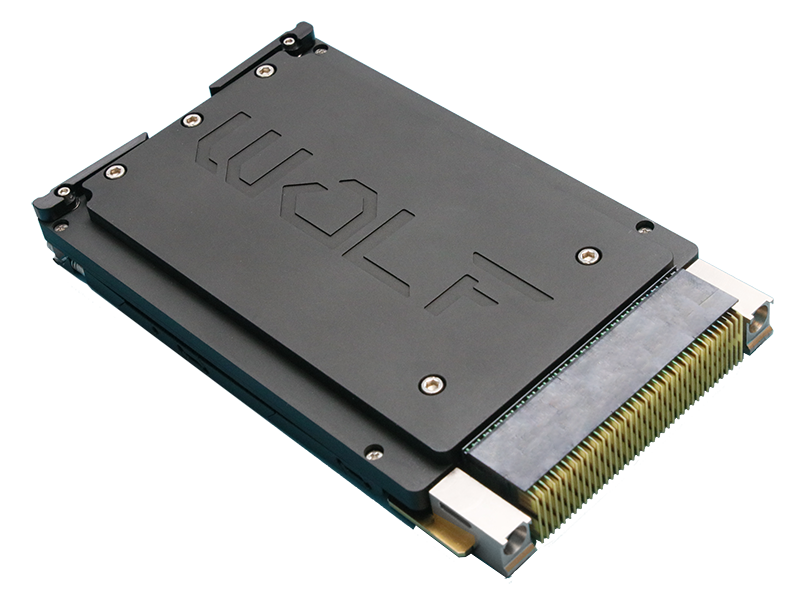
HPEC with NVIDIA RTX 2000 Ada and PCIe Gen4 Switch
The VPX3U-AD2000E-VO module includes an NVIDIA RTX 2000 Ada embedded GPU and a PCIe Gen4 switch in a rugged 3U VPX module. The NVIDIA RTX 2000 embedded GPU provides the advanced processing capabilities for high performance embedded computing (HPEC) and artificial intelligence (AI) processing.
The NVIDIA Ada architecture includes CUDA cores for HPEC, 4th generation Tensor cores for AI and data science computations, and 3rd generation Ray Tracing (RT) cores for visually accurate rendering. The Ada GPU uses a new TSMC 4N NVIDIA Custom Manufacturing Process which increases efficiency. The denser Ada GPUs have more CUDA and Tensor cores operating at higher clock frequencies at the same power, delivering significantly more performance per watt compared to WOLF’s previous generation product. The 1578 can achieve up to two times the GFLOPS/W (depending on power and GPU temperature) compared to previous-generation WOLF modules.
Unlocking the best performance requires the best cooling capability. WOLF’s advanced cooling technology is designed to move heat using a low weight, high efficiency path from the GPU die to the wedgelocks.
Features
WOLF-1578 is a rugged 3U VPX module built around an NVIDIA RTX 2000 Ada embedded GPU and a configurable PCIe Gen4 switch to support embedded AI and HPEC processing with flexible VPX backplane integration. It includes 8 GB GDDR6 128-bit VRAM with ECC support and provides up to 3 DisplayPort outputs with options for DVI or HDMI by configuration. Module power is configurable from 45W to 100W, and the design supports either SOSA aligned profile 14.6.11 (with P2 depopulated) or the SOSA Legacy payload slot profile 14.2.3.
GPU Features
- Ada GPU parallel processing:
- CUDA Toolkit 12, CUDA Compute capability 8.9
- CUDA-X AI and CUDA-X HPEC libraries
- OpenCL 3.0, DirectX 12 Ultimate, OpenGL 4.6, OpenGL ES 3.2, Vulkan 1.2
- 96 Tensor Cores (4th Gen)
- 24 Ray Tracing cores (3rd Gen)
- NVENC (8th Gen) and NVDEC (5th Gen) with up to 8K video encoding and hardware decoding support
Connectivity / System Management
- IPMI system management
- NVIDIA GPUDirect RDMA support
- Configurable PCIe Gen4 switch
- Linux and Windows drivers
- Ada GPU support requires one of the following host CPUs: Intel H/HX/P/PX/S/U Class, AMD H/HS/U Class
Mechanical / Open Systems Architecture
- High level of ruggedization:
- Rugged conduction cooled (CC) or air cooled (AC)
- Operating temperature: CC: - 40°C to +70°C standard, operational to +85°C AC: - 40°C to +60°C standard, operational to +71°C
- Vibration (sine wave): 10G peak, 5 - * Shock: CC: 40G peak AC: 30G peak
- Dimensions: 160mm x 100mm x 25.4mm
- Weight (approximately): CC: 1.4kg
- ANSI/VITA 48, 65 (VPX- REDI, OpenVPX)
- SOSA Aligned profile support: 14.6.11 (with P2 depopulated) or the SOSA Legacy payload slot profile 14.2.3
- Guide- pin receptacles are unkeyed by default
Specifications
Key configuration and performance parameters for WOLF-1578 are summarized below for quick comparison. Values shown reflect the standard module configuration; contact WOLF if you need a tailored build or a specific payload profile.
Configuration Guide
The following table defines series of common order codes for the VPX3U-AD2000E-VO module. The asterisks denote characters of the part number that are defined based on common configuration options.
Some configuration options for this module include:
- Display Interfaces
- Conformal Coatings
- Variant Locked
- Default Power Threshold
- PCIe Configuration Options
- SOSA or OpenVPX profiles
Contact Sales for the latest Ordering Numbers and available options.
Representative ordering numbers
| Ordering Number | Description |
|---|---|
| 157833-F***-***VPX3vA0 | 3U VPX, Conduction Cooled, 1”, OpenVPX, NVIDIA Ada RTX 2000, 8GB GDDR6, PCIe up to Gen4, Rear: 3x DP/HDMI/DVI out |
| 157823-F***-***VPX3vA0 | 3U VPX, Air Cooled, 1”, OpenVPX, NVIDIA Ada RTX 2000, 8GB GDDR6, PCIe up to Gen4, Rear: 1x DP/HDMI/DVI out, Front: 2x DP/HDMI/DVI |
| 157833-F***-***VPX3vA0 | 3U VPX, Conduction Cooled, 1”, SOSA 14.6.11 with P2 depopulated, NVIDIA Ada RTX 2000, 8GB GDDR6, PCIe up to Gen4, no video output |
Related Products
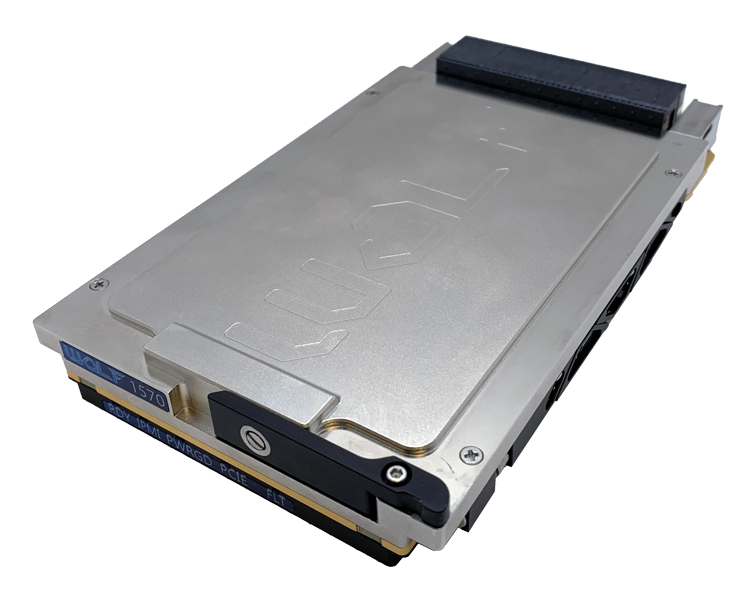
- NVIDIA RTX 2000 Ada (AD107)
- 3072 CUDA Cores, 96 Tensor Cores
- 8 GB GDDR6 VRAM
- PCIe Gen 4
- SOSA Payload, SOSA Legacy, OpenVPX
- Module power 45–120 W
FAQ
Choose WOLF-1578 when you want a strong balance of compute capability, lower power, and native display outputs in a rugged 3U VPX module.
This module is commonly selected when:
- You are power/thermal constrained and want to stay in a 45W-100W class envelope
- The workload is AI/HPEC that fits well within RTX 2000-class performance
- You need up to 3x DisplayPort outputs (with HDMI/DVI options by configuration)
If your performance target requires higher sustained throughput and the chassis can cool it, an RTX 5000-class module is the typical step up.
It improves flexibility for PCIe routing and platform alignment.
In practice it helps when:
- Your chassis has fixed lane routing constraints
- You need a clean way to integrate the GPU as part of a broader PCIe topology
- You expect variant builds that change PCIe presentation without changing the compute module
If your PCIe topology is simple and stable, you may not need the added flexibility, but it can reduce integration risk in multi-variant programs.
Confirm these early to prevent backplane surprises:
- Slot profile support: SOSA-aligned 14.6.11 (P2 depopulated) or SOSA legacy 14.2.3
- Video routing expectation: up to 3x DisplayPort outputs (configuration dependent)
- PCIe uplink expectations: confirm lane width and routing per your chassis/backplane design
Profile selection impacts what I/O is realistically available and where it can be routed.
Key ordering-time decisions are usually integration-fit choices:
- Slot profile selection: 14.6.11 vs 14.2.3 impacts compatibility
- Display configuration: DP-only vs DP with HDMI/DVI options
- Power threshold (45W-100W envelope): must match chassis cooling
- Program controls: conformal coating and variant locking for deployed environments
Contact Sales for the latest ordering numbers and available configuration options.