WOLF-30D0
Block Diagram
The block diagram illustrates an XMC development carrier with a PCIe edge interface, highlighting the primary PCIe x8 path between host and the mounted XMC module. It emphasizes how SDI/analog/DP-class I/O is broken out to external connectors to validate capture, conversion, and display signal paths during development.
Overview
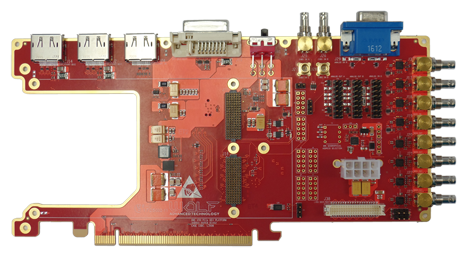
XMC Development Carrier with Multi-Format Video I/O
The XMC-DEV-IO is a development carrier board designed to evaluate and integrate WOLF XMC VPU (Video Processing Unit) and XMC FGX (Frame Grabber eXtreme) modules on the bench. It provides a convenient way to bring module I/O out to accessible connectors while running the XMC card through a host PC.
The carrier exposes multi-format video connectivity, including SDI inputs and SDI outputs, multiple CVBS inputs, and analog inputs and outputs for legacy and mixed-signal workflows. For VPU-based configurations, the board also supports additional display connectivity such as DisplayPort and DVI, along with supporting power features intended to simplify lab bring-up.
The mounted XMC module is accessed through a standard PCIe slot using a PCIe x8 interface, enabling straightforward connection to development workstations for software bring-up, signal validation, and end-to-end pipeline testing.
Features
WOLF-30D0 is an XMC development carrier board designed to evaluate and integrate WOLF XMC VPU (Video Processing Unit) and XMC FGX (Frame Grabber eXtreme) modules on the bench. It exposes common video I/O connectors for signal validation while providing a PCIe x8 interface through a 16-lane PCIe edge connector for host PC connectivity.
Video I/O Features
- 2 SDI inputs
- 2 SDI outputs
- 4 CVBS inputs
- 4 analog inputs and outputs
- For VPU module configurations: DisplayPort output and DVI output
Connectivity / System Management
- PCIe x8 interface to host PC via x16 PCIe edge connector
Mechanical / Open Systems Architecture
- Bench development carrier for XMC modules
- Provides connector breakouts for lab bring- up and integration testing
Specifications
Key configuration and performance parameters for WOLF-30D0 are summarized below for quick comparison. Values shown reflect the standard module configuration; contact WOLF if you need a tailored build or a specific payload profile.
Configuration Guide
This development carrier is typically ordered with configuration-dependent I/O breakout and connector population. Contact Sales for the latest ordering numbers and available options.
Some configuration options for this board include:
- Video I/O breakout population (SDI I/O, CVBS, and analog I/O as supported by the installed XMC module)
- VPU-oriented display breakout population (DisplayPort/DVI class connectivity where applicable)
- Lab bring-up conveniences (jumpers/switches and test access as required)
Representative ordering numbers
| Ordering Number | Description |
|---|---|
| Contact Sales | XMC-DEV-IO ordering and configuration options |
Related Products
FAQ
WOLF-30D0 (XMC-DEV-IO) is a bench development carrier for evaluating WOLF XMC VPU and XMC FGX modules using a host PC.
Expect:
- Easy access to I/O connectors for signal validation and pipeline testing
- Straightforward PCIe-based host integration for driver/software bring-up
Do not expect:
- Deployed rugged packaging equivalent to VPX chassis integration
- A fixed “production I/O map” independent of the installed XMC module—carrier breakouts are meant for development flexibility.
Typical high-value tests:
- Driver bring-up and enumeration over PCIe x8
- SDI and analog signal integrity checks using lab sources/sinks
- End-to-end encode/display pipeline testing (module dependent)
- Connector/harness proof-of-concept for the intended I/O set
The goal is to reduce risk in software, signal chain assumptions, and interoperability before moving into a rugged enclosure or chassis.
It exposes:
- 2 SDI inputs and 2 SDI outputs
- 4 CVBS inputs
- 4 analog inputs and outputs
- For VPU-based configurations: DisplayPort output and DVI output
Note: the effective set depends on the installed XMC module and configuration.
Dev carriers are commonly ordered as configuration-driven tools (connector population and any lab bring-up options).
Contact Sales for ordering information and available configuration options.