WOLF-1448
Block Diagram
The block diagram illustrates the RTX A4500 (Ampere) GPU as the primary compute engine with an onboard PCIe Gen4 switch for VPX backplane connectivity and expansion. It highlights the PCIe paths used to move data into the GPU for HPEC/AI workloads and the display routing used for multi-output visualization configurations.
Overview
HPEC with NVIDIA RTX A4500 and PCIe Gen4 Switch
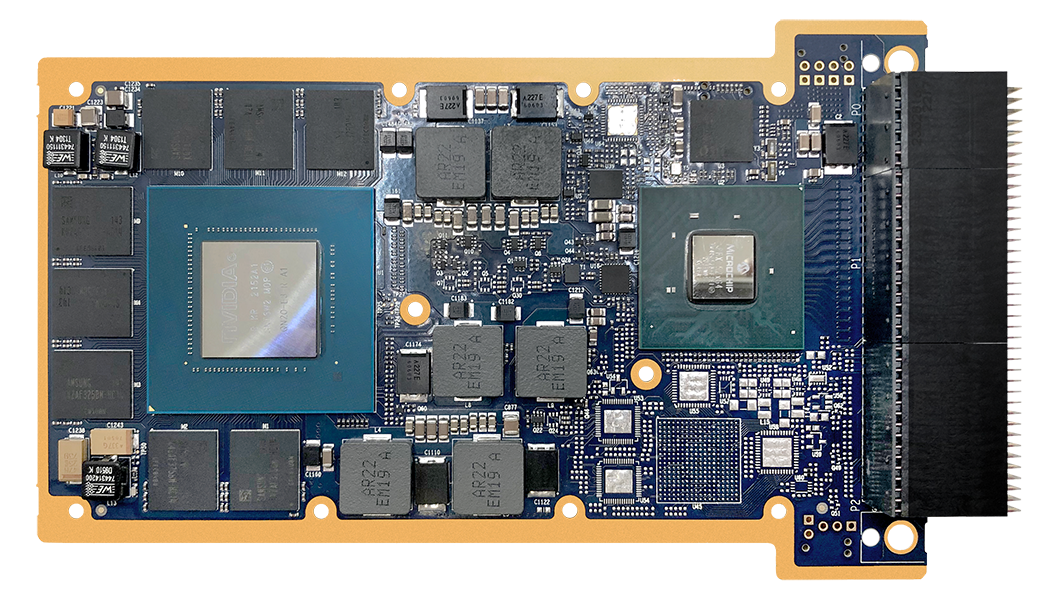
The VPX3U-A4500E-VO module includes an NVIDIA RTX A4500 embedded GPU in a rugged 3U VPX module. Built on the NVIDIA Ampere architecture this GPU includes CUDA cores for parallel processing, Tensor cores for dedicated AI-accelerated compute, and Ray Tracing cores for superior rendering speeds. This module also includes a configurable PCIe Gen4 switch.
The NVIDIA Ampere architecture has introduced many significant improvements to the performance and efficiency of the GPU, with more flexible CUDA FP32/INT core use, more efficient third generation Tensor cores, and second generation RT cores. The Ampere GPU fabrication uses an 8nm manufacturing process which provides significant power improvements which, along with other Ampere architecture improvements, can provide up to 154 GFLOPS/W, providing almost twice the performance per slot compared to the previous Turing generation’s 86 GFLOPS/W or the Pascal generation’s 62 GFLOPS/W.
Unlocking the best performance requires the best cooling capability. This module takes advantage of WOLF Advanced Metal, a material which provides lower thermal resistance between the GPU and the wedgelocks, allowing the GPU to run at higher power levels to achieve higher performance.
Features
WOLF-1448 is a rugged 3U VPX module built around an NVIDIA RTX A4500 Ampere embedded GPU and a configurable PCIe Gen4 switch to support embedded AI, HPEC, and visualization workloads. It includes 16 GB GDDR6 256-bit memory (up to 512 GB/s) and supports four simultaneous DisplayPort 1.4 outputs with optional HDMI and DVI interfaces by configuration. The GPU connects via PCIe x16 Gen4, module power is configurable from 70W to 160W, and the design supports OpenVPX slot profiles with SOSA aligned configuration options.
GPU Features
- Four simultaneous DisplayPort 1.4 outputs:
- 4K at 120Hz or 8K at 60Hz with 10-bit color depth
- Support for High Dynamic Range (HDR) video
- HDMI and DVI options
- Ampere GPU parallel processing:
- CUDA Toolkit 12, CUDA Compute capability 8.6
- OpenCL 3.0, DirectX 12 Ultimate, OpenGL 4.6, OpenGL ES 3.2, Vulkan 1.2
- 184 Tensor Cores (3rd Gen), 68 (dense) / 136 (sparse) Tensor TFLOPS
- 46 Ray Tracing cores (2nd Gen)
- NVENC (7th Gen) and NVDEC (5th Gen) with up to 8K video encoding and hardware decoding support
Connectivity / System Management
- On-board IPMI controller for system management
- GPU with PCIe x16 Gen4 interface
- Configurable PCIe Gen4 switch
- Daisy Chain option supported
- Linux and Windows drivers
- NVIDIA Ampere driver support requires the following host CPU: Intel E, S/H/H35 or AMD H/HS Class
Mechanical / Open Systems Architecture
- High level of ruggedization:
- Rugged conduction cooled
- Operating temperature: - 40°C to +70°C standard, operational to +85°C
- Vibration (sine wave): 10G peak, 5 - * Shock: 40G peak
- Dimensions: 160mm x 100mm x 25.4mm
- Weight (approximately): 1.3 kg
- ANSI/VITA 48, 65 (VPX- REDI, OpenVPX)
- SOSA aligned options with depopulated P2 or support for the SOSA Legacy payload slot profile 14.2.3
Specifications
Key configuration and performance parameters for WOLF-1448 are summarized below for quick comparison. Values shown reflect the standard module configuration; contact WOLF if you need a tailored build or a specific payload profile.
Configuration Guide
The following table defines series of common order codes for the VPX3U-A4500E-VO module. The asterisks denote characters of the part number that are defined based on common configuration options.
Some configuration options for this module include:
- Display Interfaces
- PCIe Configuration Options
- Variant Locked
- Default Power Threshold
- Conformal Coatings
- P2 depopulated (SOSA aligned)
Contact Sales for the latest Ordering Numbers and available options.
Representative ordering numbers
| Ordering Number | Description |
|---|---|
| 144833-F001-000VPX3vA0 | 3U VPX, Conduction Cooled, 1”, OpenVPX, NVIDIA Ampere RTX A4500, 16GB GDDR6, PCIe up to Gen4, Rear: 4x DisplayPort output |
| 144833-F005-000VPX3vA0 | 3U VPX, Conduction Cooled, 1”, SOSA 14.6.11 profile with P2 depopulated, NVIDIA Ampere RTX A4500, 16GB GDDR6, PCIe up to Gen4, no video output |
| 144833-F005-001VPX3vA0 | 3U VPX, Conduction Cooled, 1”, SOSA 14.6.11 profile with P2 depopulated, NVIDIA Ampere RTX A4500, 16GB GDDR6, PCIe up to Gen4, Rear: 4x DisplayPort output |
Related Products
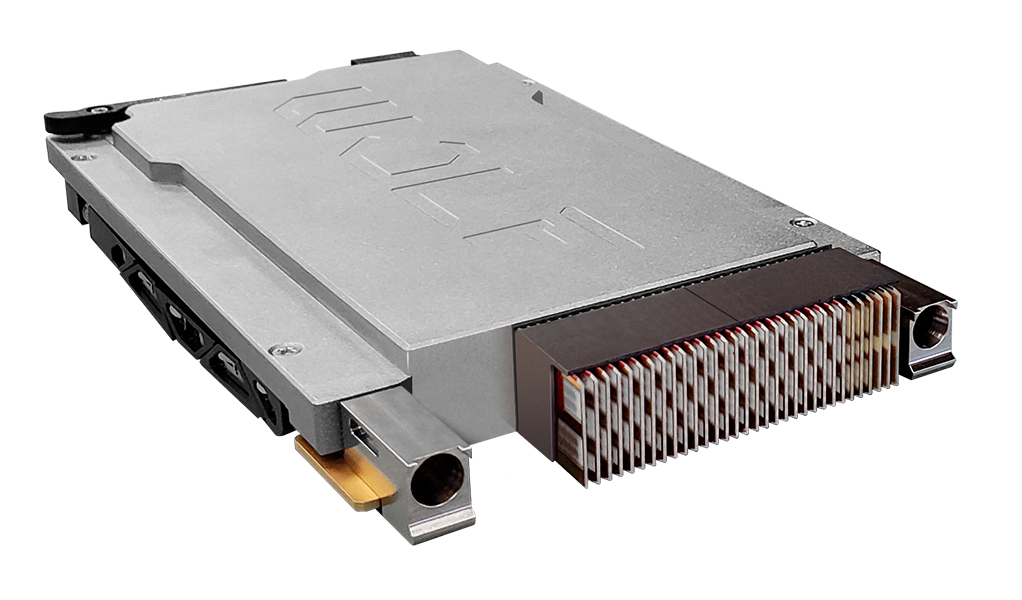
- NVIDIA RTX A4500 (GA104)
- 5888 CUDA Cores, 184 Tensor Cores
- 16 GB GDDR6 VRAM
- PCIe Gen 4, 100GbE
- SOSA Payload
- Module power 100–140 W
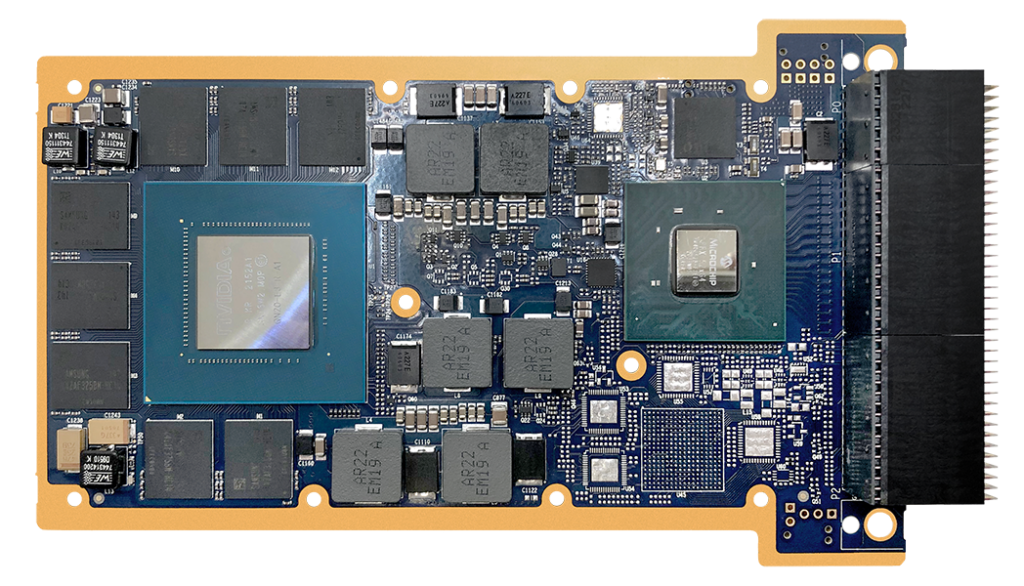
- NVIDIA RTX A4500 (GA104)
- 5888 CUDA Cores, 184 Tensor Cores
- 16 GB GDDR6 VRAM
- PCIe Gen 4
- SOSA Payload, SOSA Legacy
- Module power 100–190 W
FAQ
WOLF-1448 is a strong fit when you need Ampere-class GPU compute with four DisplayPort outputs and a PCIe Gen4 switch, and you are optimizing for platform continuity, qualification reuse, or program constraints.
It often makes sense when:
- The program baseline is Ampere-qualified
- You want a stable compute + display configuration with known integration characteristics
- Your performance needs are met without moving to a newer GPU generation
If you are starting a new design and can absorb requalification, newer GPU generations typically offer better performance per watt, but the right choice depends on program risk and schedule.
Confirm output count and routing expectations early because this module is often chosen for visualization.
Planning points:
- Supports four DisplayPort 1.4 outputs simultaneously
- HDMI/DVI options are available by configuration
- Confirm whether your chassis expects rear-routed display outputs and how they are cabled to downstream displays
Locking the display plan early prevents late changes to rear I/O and platform harnessing.
It provides flexibility for how PCIe is routed to/from the GPU and peers.
This matters when:
- You need to align to different OpenVPX/SOSA routing patterns
- You want to support multiple system variants without redesigning the compute card
- You may require daisy-chain or multi-endpoint PCIe arrangements
If your chassis PCIe topology is fixed and minimal, the switch may be less value-driving; if your topology is constrained or evolving, it reduces integration risk.
The main decisions map to system integration:
- Slot profile/build type: OpenVPX vs SOSA-aligned builds (including depopulation expectations)
- Display configuration: DP outputs and HDMI/DVI options
- PCIe configuration: lane presentation and switch behavior
- Power threshold (70W-160W envelope): must match chassis cooling
Contact Sales for the latest ordering numbers and available configuration options.