WOLF-153W
Block Diagram
The block diagram illustrates the RTX 5000E (AD103) GPU coupled to a ConnectX-7 SmartNIC with a PCIe Gen4 backplane uplink and two 40/100GBASE optical fabric links routed to P2A and P2B under SOSA payload profile 14.6.11-0.
Overview
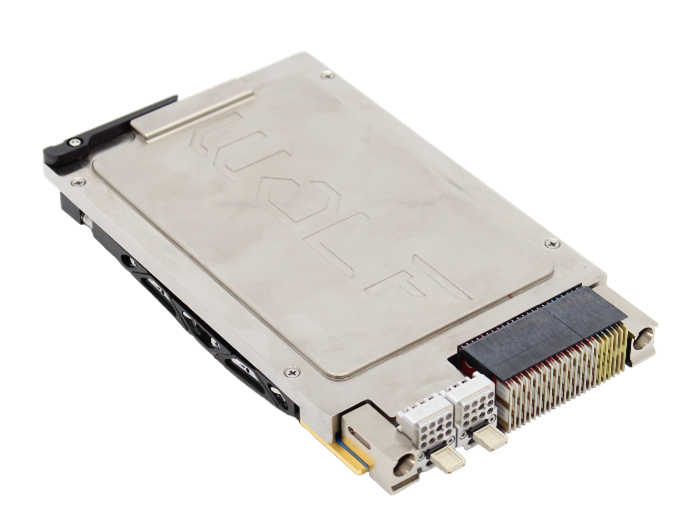
HPEC with NVIDIA Ada RTX 5000E, ConnectX-7 SmartNIC, and 40/100GbE Optical Fabric
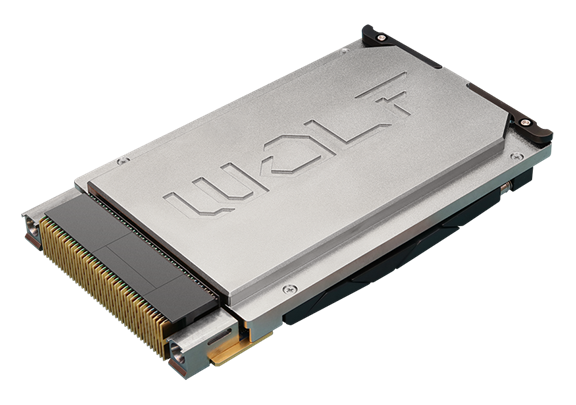
The VPX3U-AD5000E-CX7-OPTICAL HPEC module integrates an NVIDIA RTX™ 5000E (AD103) embedded GPU with an NVIDIA® ConnectX®-7 SmartNIC to provide high-performance embedded computing (HPEC) and AI acceleration with secure, high-bandwidth networking.
ConnectX-7 provides PCIe connectivity plus **dual 40/100GBASE optical fabric interfaces for efficient movement of large datasets, including RoCE and NVIDIA GPUDirect RDMA support for low-latency data transfer.
The module includes 16 GB GDDR6 (256-bit) VRAM with ECC, and a configurable 100W to 140W power envelope. At a default 80W TGP, the GPU provides up to 18.1 TFLOPS at base clock and up to 32.7 TFLOPS at boost clock (cooling dependent).
Features
WOLF-153W is a rugged 3U VPX HPEC module that combines an NVIDIA RTX 5000E Ada GPU with an NVIDIA ConnectX-7 SmartNIC and dual 40/100GBASE optical fabric interfaces (P2A/P2B) to support secure, high-throughput AI/HPC pipelines in deployed environments. It includes 16 GB GDDR6 ECC VRAM and a configurable 100W to 140W power envelope for platform thermal tuning.
GPU Features
- Ada GPGPU parallel processing:
- CUDA Toolkit 12, CUDA Compute capability 8.9
- CUDA-X AI and CUDA-X HPEC libraries
- OpenCL 3.0, DirectX 12 Ultimate, OpenGL 4.6, OpenGL ES 3.2, Vulkan 1.2
- 9728 CUDA Cores
- 304 Tensor Cores (4th Gen)
- 76 Ray Tracing (RT) Cores (3rd Gen)
- NVENC (8th Gen) and NVDEC (5th Gen) with up to 8K video encode/decode support
Connectivity / System Management
- On-board IPMI controller for system management
- PCIe configurable switch
- Switching offload to ConnectX using NVIDIA ASAP2 technology
- Daisy-chain options
- Dual 40/100GBASE optical fabric links (P2A & P2B)
- GPUDirect RDMA and RoCE support
- Block-level hardware encryption with dedicated keys per user
- Linux and Windows drivers
Mechanical / Open Systems Architecture
- Rugged conduction cooled
- Operating temperature: -40°C to +70°C standard, operational to +85°C
- Vibration (sine): 10G peak (5–2000 Hz)
- Shock: 40G peak
- Dimensions: 160mm x 100mm x 25.4mm
- Weight (approximately): 1.3 kg
- SOSA Aligned Payload slot profile: 14.6.11-0 (P2A & P2B Optical)
Specifications
Key configuration and performance parameters for WOLF-153W are summarized below for quick comparison. Values shown reflect the standard module configuration; contact WOLF if you need a tailored build or a specific payload profile.
Configuration Guide
The following table defines series of common order codes for the VPX3U-AD5000E-CX7-OPTICAL module. Asterisks (*) indicate configurable options.
Contact Sales for the latest ordering numbers and available options.
Representative ordering numbers
| Ordering Number | Description |
|---|---|
| 153W33-F***-***VPX3vA0 | 3U VPX, Conduction Cooled, NVIDIA Ada RTX5000E (AD103), ConnectX-7, SOSA Payload 14.6.11-0 with dual 40/100GBASE optical (P2A & P2B) |
Related Product:
- 153L33-F***-***VPX3vA0 | 3U VPX, Conduction Cooled, NVIDIA Ada RTX5000, ConnectX-7, SOSA payload profile with P2 or P2B depopulated
Related Products
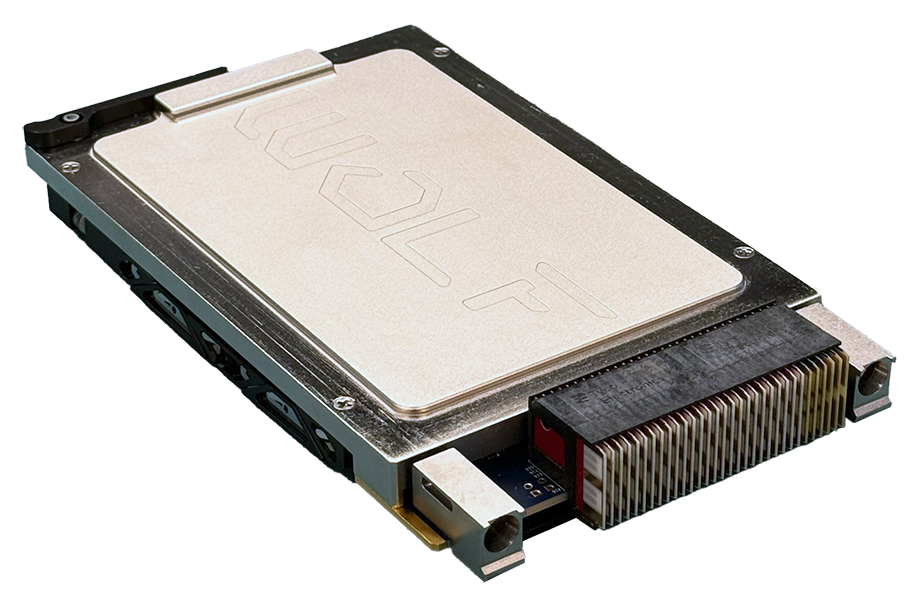
- NVIDIA RTX 5000 Ada (AD103)
- 9728 CUDA Cores, 304 Tensor Cores
- 16 GB GDDR6 VRAM
- PCIe Gen 4, 100GbE
- SOSA Payload
- Module power 100–140 W
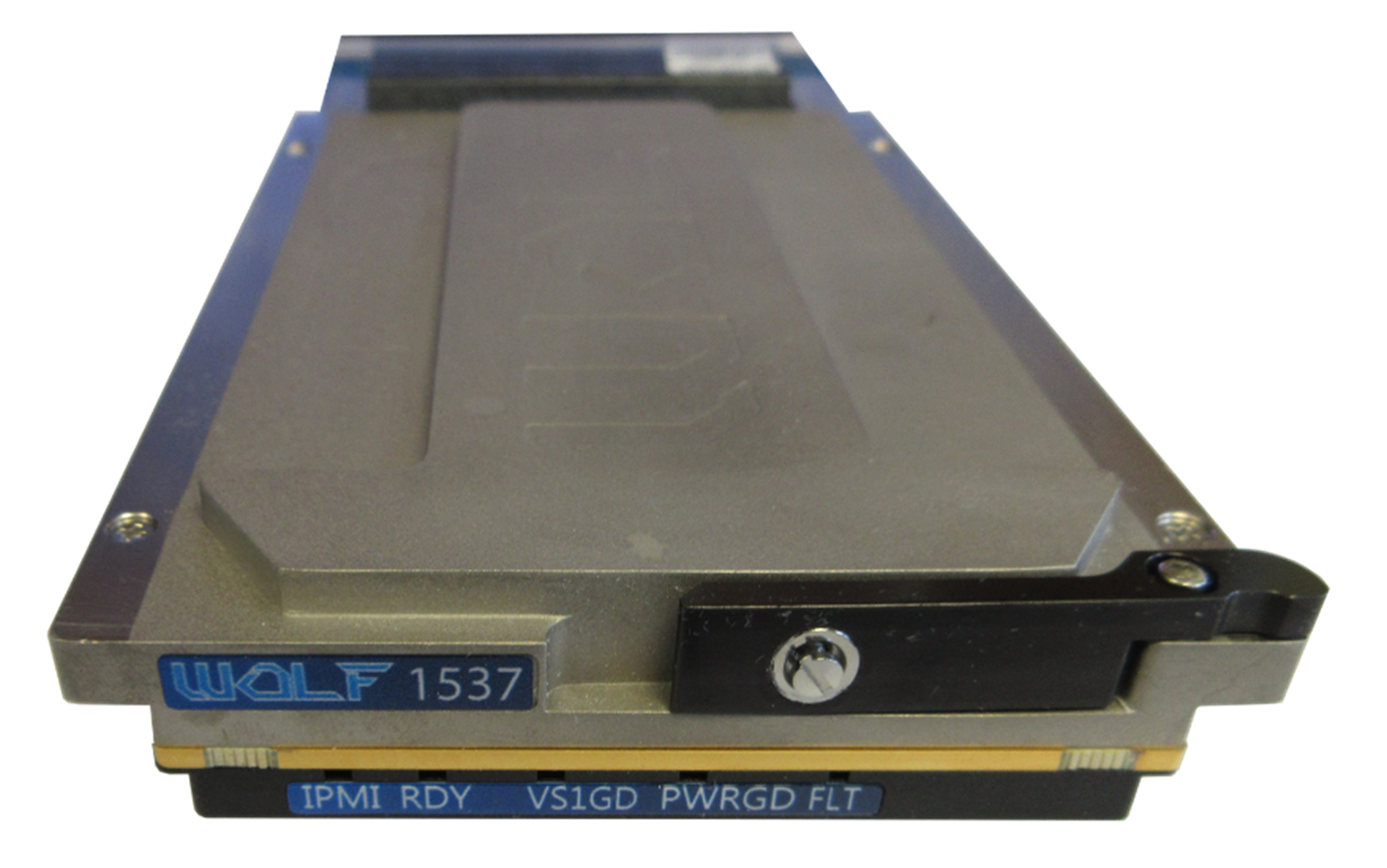
- NVIDIA RTX 5000 Ada (AD103)
- 9728 CUDA Cores, 304 Tensor Cores
- 16 GB GDDR6 VRAM
- PCIe Gen 4
- OpenVPX
- Module power 80–140 W
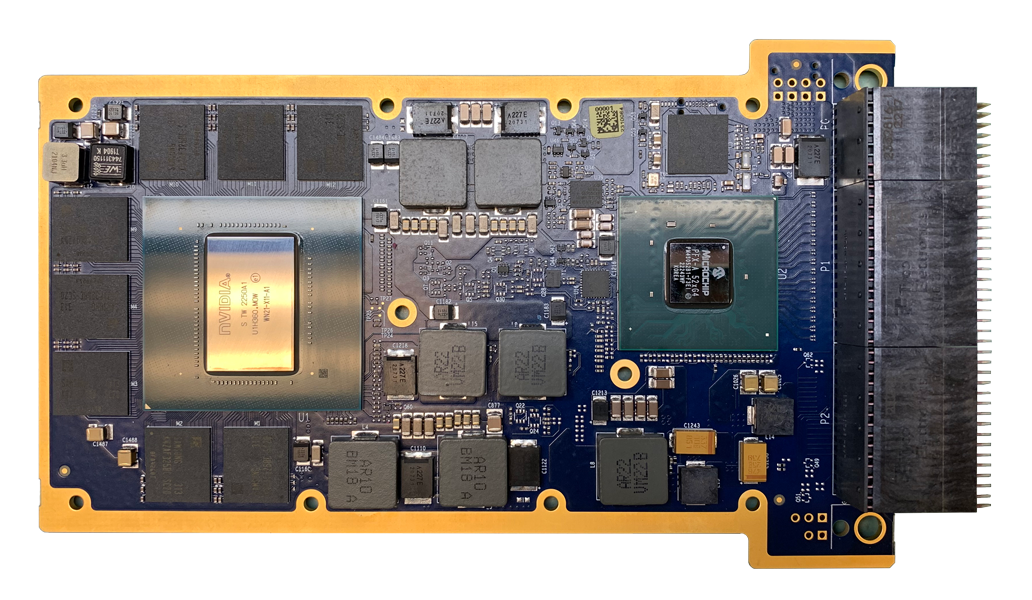
- NVIDIA RTX 5000 Ada (AD103)
- 9728 CUDA Cores, 304 Tensor Cores
- 16 GB GDDR6 VRAM
- PCIe Gen 4
- SOSA Payload, SOSA Legacy
- Module power 60–140 W
- NVIDIA RTX 5000 Ada (AD103)
- 9728 CUDA Cores, 304 Tensor Cores
- 16 GB GDDR6 VRAM
- PCIe Gen 4
- OpenVPX
- Module power 70–140 W
FAQ
Choose WOLF-153W when your system needs Ada RTX 5000-class GPU compute plus high-bandwidth optical networking through ConnectX-7.
This module is typically selected when:
- You need dual 40/100GBASE optical fabric links routed through P2A and P2B
- You want ConnectX-7 networking with RoCE and GPUDirect RDMA for low-latency data movement
- You need a GPU + SmartNIC module for high-rate sensor ingest or distributed processing
- Your platform benefits from optical links for distance, EMI/EMC, or system partitioning reasons
If your system uses electrical KR Ethernet instead of optical fabric, WOLF-153L may be the closer fit. If your workload is mostly local GPU compute with modest networking, a GPU-only module such as WOLF-1538 may be simpler.
The dual 40/100GBASE optical links provide high-bandwidth fabric connectivity through the VPX backplane while reducing dependence on copper Ethernet routing.
This matters most when:
- Large datasets need to move between payload modules, switches, or external processing nodes
- Optical routing is preferred for distance, signal integrity, or EMI/EMC considerations
- The system architecture requires high-throughput network ingress directly into GPU-accelerated processing pipelines
- RoCE and GPUDirect RDMA are used to reduce CPU copies and lower end-to-end latency
In practice, the optical fabric links make WOLF-153W a strong fit for distributed AI/HPC systems where data movement is as important as GPU compute.
Confirm these early to avoid backplane, optical, and thermal integration issues:
- Slot profile: SOSA payload profile 14.6.11-0 with P2A and P2B optical routing
- Optical fabric support: confirm the chassis/backplane supports the required dual 40/100GBASE optical links
- Optical connector and cabling strategy: validate transceiver, fiber, bend radius, service access, and link budget assumptions
- PCIe topology: confirm PCIe Gen4 routing, switch configuration, and any daisy-chain assumptions
- Network architecture: confirm RoCE, GPUDirect RDMA, and ASAP2 offload expectations across the full fabric
- Power and cooling: confirm the chassis supports the selected 100W to 140W power envelope for sustained operation
For optical SmartNIC modules, the highest-risk items are usually optical routing, chassis compatibility, and end-to-end fabric validation.
The key ordering-time choices are driven by optical fabric integration, PCIe topology, and program controls:
- Optical fabric configuration: confirms dual 40/100GBASE optical links on P2A and P2B
- Slot profile selection: SOSA 14.6.11-0 with P2A and P2B optical routing must match the chassis design
- PCIe switch configuration: determines how host, GPU, SmartNIC, and backplane PCIe paths are presented
- Power threshold: choose a 100W to 140W configuration that matches chassis thermal capability
- Conformal coating and variant locking: support deployed programs with environmental and configuration-control requirements
- Related product decision: use WOLF-153L if the system requires a non-optical ConnectX-7 configuration instead
Contact Sales for the latest ordering numbers and available configuration options.