WOLF-2348
Block Diagram
The block diagram depicts a 6U VPX dual-GPU compute module with two Turing RTX5000 GPUs, emphasizing the PCIe data paths used to feed both GPUs and provide high-throughput transfers to the host system. It highlights the internal GPU connectivity strategy (via the module’s PCIe fabric) and the display routing used for multi-output mission visualization.
Overview
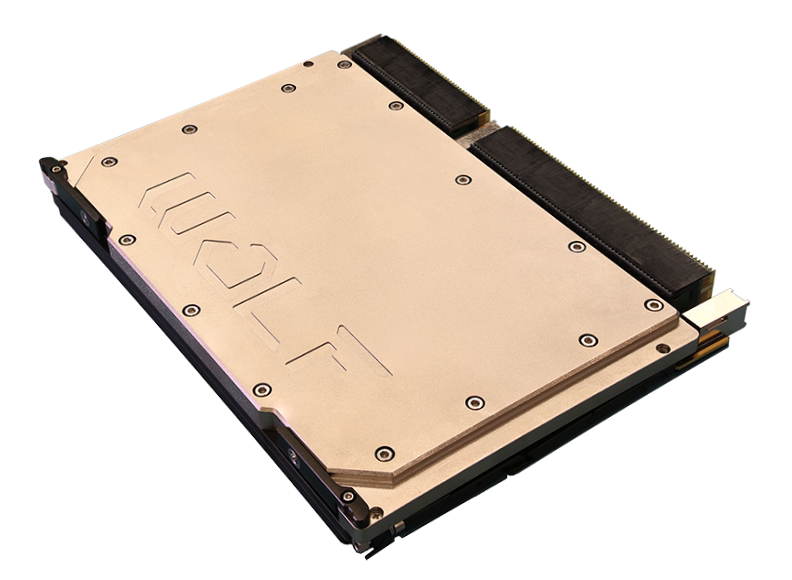
Dual Turing RTX5000 GPUs for HPEC and AI
The VPX6U-RTX5000E-DUAL-VO module includes two NVIDIA Quadro Turing RTX5000 embedded GPUs in a rugged 6U VPX module. The RTX5000 includes CUDA cores for parallel processing, Tensor cores for dedicated AI inference, and Ray Tracing cores for superior rendering speeds.
Getting data into and out of the module is an important consideration for this high-speed GPU. Support for GDDR6 memory provides twice the bandwidth of the previous generation’s GDDR5 memory.
The Turing GPU with its Tensor cores provides this module with the underlying architecture required for an efficient AI inference engine. Intended to work in conjunction with TensorRT, CUDA and cuDNN, the Turing Tensor Core design adds INT8 and INT4 matrix operations, while continuing to support FP16 for higher precision workloads.
Unlocking the best performance requires the best cooling capability. WOLF’s advanced cooling technology is designed to move heat using a low weight, high efficiency path from the GPU die to the wedgelocks.
Features
WOLF-2348 is a rugged 6U VPX module that integrates two NVIDIA Quadro RTX 5000 Turing embedded GPUs with a configurable PCIe Gen3 x16 switch to deliver high-density HPEC and AI inference performance with multi-display output. It includes 32 GB GDDR6 256-bit memory with ECC support and provides eight DisplayPort outputs with HDMI and DVI options by configuration. Module power is configurable from 100W to 300W, and the design supports conduction-cooled or air-cooled operation with SOSA aligned profile support 10.6.4.
GPU Features
- Eight DisplayPort 1.4 digital video outputs:
- Support for High Dynamic Range (HDR) video
- 4K at 120Hz or 8K at 60Hz with 10-bit color depth
- HDMI and DVI options available
- Turing GPU parallel processing:
- CUDA Toolkit 10, CUDA Compute capability 7.5
- OpenCL 3.0, DirectX 12 Ultimate, OpenGL 4.5, Vulkan 1.1
- 768 Turing Cores for advanced AI inference
- 32 GB GDDR6 memory, up to 448 GB/s to each GPU
- HEVC (H.265) and AVC (H.264) Turing NVENC and NVDEC hardware acceleration with up to 8K encode resolution and B-frame support
Connectivity / System Management
- PCIe x16 Gen3 configurable PCIe switch
- Daisy Chain option supported
- NVLink 2.0 x8 high-speed GPU interconnect option provides 25 GB/sec peak bandwidth per direction between two GPUs (50 GB/sec bidirectional)
- Windows and Linux drivers
- On-board IPMI controller for system management
Mechanical / Open Systems Architecture
- High level of ruggedization:
- Rugged Conduction cooled (CC) or Air cooled (AC)
- Operating temperature: - 40° to +85°C for CC, - 40° to +71°C for AC
- Vibration (sine wave): 10G peak, 5 - * Shock: 40G peak for conduction cooled, 30G peak for air cooled
- Dimensions: 160mm x 233mm x 25.4mm
- Weight: 1.7 kg for conduction cooled, 1.3 kg for air cooled
- ANSI/VITA 48, 65 (VPX- REDI, OpenVPX)
- SOSA Aligned options
Specifications
Key configuration and performance parameters for WOLF-2348 are summarized below for quick comparison. Values shown reflect the standard module configuration; contact WOLF if you need a tailored build or a specific payload profile.
Configuration Guide
The following table defines a series of common order codes for the VPX6U-RTX5000E-DUAL-VO module. The asterisks denote characters of the part number that are defined based on common configuration options.
Some common configuration options for this module include:
- Display interfaces
- Conformal coating type
- COTS, MCOTS, or locked
- PCIe switch configuration
- SOSA aligned configurations
- NVLink for dual GPU modules
6U VPX Turing RTX5000 sample configurations
Contact Sales for the latest Ordering Numbers and available options
Representative ordering numbers
| Ordering Number | Description |
|---|---|
| 234823-F***-***VPX6vA0 | 6U VPX, air cooled, 1", dual NVIDIA Turing RTX5000, 8x video outputs |
| 234833-F***-***VPX6vA0 | 6U VPX, conduction cooled, 1", dual NVIDIA RTX5000, 8x video outputs |
| 234823-F***-***VPX6vA0 | 6U VPX, air cooled, 1", single NVIDIA Turing RTX5000, 4x video outputs |
| 234833-F***-***VPX6vA0 | 6U VPX, conduction cooled, 1", single NVIDIA RTX5000, 4x video outputs |
Related Products
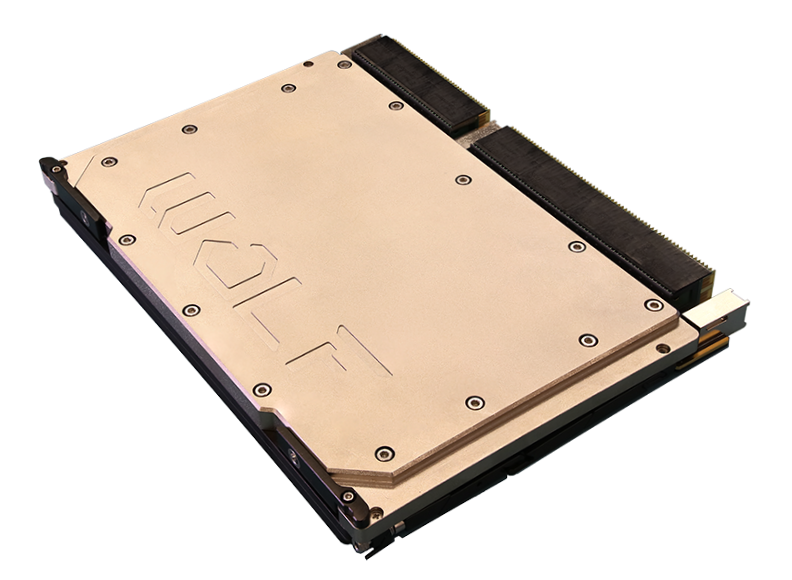
- NVIDIA RTX 5000 Blackwell (GB203)
- 10496 CUDA Cores, 320 Tensor Cores
- 24 GB GDDR7 VRAM
- PCIe Gen 4
- SOSA Payload
- Module power 190–320 W
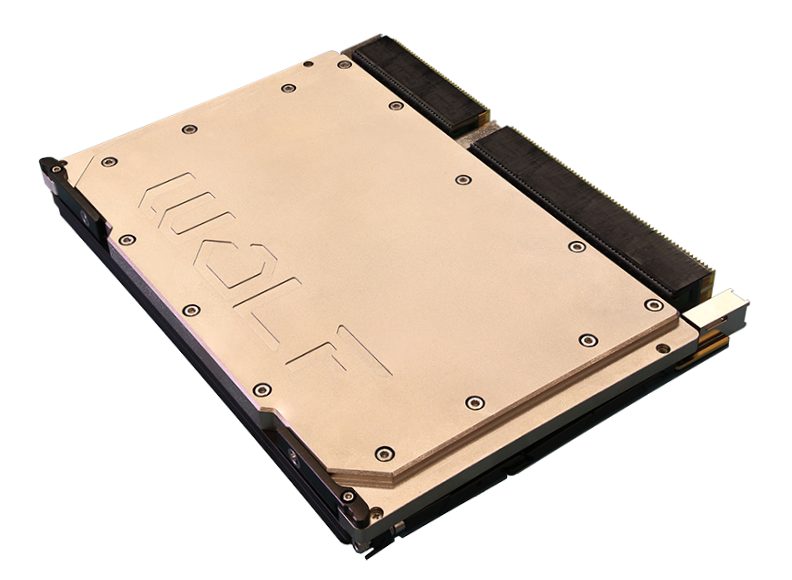
- NVIDIA RTX 5000 Ada (AD103)
- 9728 CUDA Cores, 304 Tensor Cores
- 16 GB GDDR6 VRAM
- PCIe Gen 4
- SOSA Payload
- Module power 150–280 W
FAQ
WOLF-2348 is typically selected for platform continuity—for example, when a program is already qualified around the Turing RTX5000 baseline, or when you need a proven dual-GPU + multi-display module with known integration characteristics.
If you are starting a new design and can adopt a newer GPU baseline, dual Ada/Blackwell modules generally provide higher performance per watt and newer software features. However, program constraints (qualification reuse, schedule, or long-term support strategy) often make WOLF-2348 the pragmatic choice in sustaining programs.
WOLF-2348 supports a PCIe-based dual-GPU architecture and includes an NVLink 2.0 x8 option for direct GPU-to-GPU interconnect.
Practical implications:
- If your workload requires frequent GPU-to-GPU data exchange, NVLink can reduce reliance on host-mediated transfers.
- If your workload is mostly independent per GPU (two separate pipelines), the benefit of NVLink may be limited.
The module also supports a daisy chain option, which can matter in certain chassis PCIe topologies. These are architectural tools—useful when the dataflow is GPU-to-GPU heavy or the chassis fabric requires chaining.
Confirm these early because they determine whether the module will meet your system constraints:
- PCIe generation: this module uses PCIe Gen3 x16. Ensure your platform throughput requirements align with Gen3 uplink behavior.
- Cooling method: supports conduction-cooled (CC) or air-cooled (AC). Confirm chassis cooling model and shock limits (AC vs CC differ).
- Display routing plan: supports up to 8 outputs with DP plus HDMI/DVI options by configuration. Decide early how displays are routed and cabled so rear I/O design is stable.
For data-heavy pipelines, validating PCIe Gen3 sufficiency early prevents late-stage performance surprises.
Key ordering-time decisions typically include:
- NVLink included or not: most valuable for GPU-to-GPU heavy workloads.
- Cooling variant (CC vs AC): drives chassis compatibility and shock ratings.
- Display interface configuration: DP output routing and HDMI/DVI options.
- PCIe switch configuration and daisy chain option: affects chassis topology integration.
- Power threshold (100W-300W envelope): must match chassis cooling for sustained operation.
Contact Sales for the latest Ordering Numbers and available options.