WOLF-30TP
Block Diagram
The block diagram shows a combined compute + video I/O XMC integrating Tegra K1 with FGX, emphasizing a “single-board” capture-to-processing path. It highlights how SDI/CVBS inputs are captured by FGX logic, routed into Tegra GPU-assisted processing, and delivered out via SDI/HDMI or encoded stream paths without relying on external host rebroadcast.
Overview
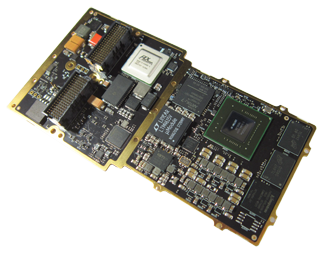
Embedded Capture and Processing with Tegra K1 and WOLF FGX
WOLF’s XMC-TK1-FGX is an image capture and processing module for aerospace and defense. It includes both an NVIDIA Tegra K1 APU and WOLF’s Frame Grabber eXtreme (FGX). The FGX can capture two HD-SDI inputs and two CVBS analog inputs. The video data can be routed to the Tegra K1 for processing and the processed data can be output as HD-SDI, HDMI or an encoded H.264 stream. The WOLF Frame Grabber eXtreme (FGX) provides conversion of video data from one standard to another, with video input and output options for both cutting-edge digital I/O and legacy analog I/O. The FGX uses a Xilinx Artix-7 FPGA to capture video without using the host system.
The XMC-TK1-FGX provides GPU-assisted parallel processing and complex analysis, performing precision intensive operations such as image processing, video stabilization, filtering, terrain analytics, 3D visualization of geospatial data, object recognition and tracking. By including both the FGX and the Tegra K1 on one board this flexible solution captures and processes images without transferring data between boards, thereby avoiding the SBC data rebroadcast traffic jams that can occur when using a 2-board solution.
Features
WOLF-30TP is a rugged XMC image capture and processing module for aerospace and defense that integrates an NVIDIA Tegra K1 APU with WOLF’s Frame Grabber eXtreme (FGX). The FGX captures two HD-SDI inputs (or one 3G-SDI input) plus two CVBS analog inputs, routes video to the Tegra K1 for processing, and supports output as HD-SDI, HDMI, or an encoded H.264 stream. The module includes 4 GB DDR3L memory and 64 GB eMMC, supports DMA and non-transparent bridging to the host PCIe bus, and provides GigE Ethernet, USB, and UART interfaces.
GPU Features
- NVIDIA Tegra K1 embedded ARM processor with Kepler GPGPU
- Kepler 192-core GPGPU with 325 GFLOPS CUDA and OpenCL programming
- 4 GB DDR3L memory
- 64 GB eMMC
- APU accelerated H.264 encoding and AAC encoding
- FGX and Tegra-K1 allows for customer-programmable FPGA options
Connectivity / System Management
- 2x HD-SDI inputs or 1x 3G-SDI input
- 2x HD-SDI outputs (SMPTE-292M)
- 2x CVBS (NTSC/PAL/SECAM) inputs
- 1x HDMI video output
- 1x GigE Ethernet
- 3x USB 2.0 interfaces
- 2x UART interfaces
- Non-transparent bridging to PCIe bus
- DMA between module and host system
- Windows and Linux drivers
Mechanical / Open Systems Architecture
- High level of ruggedization:
- Rugged air- cooled or conduction- cooled
- Operating temperature: - 40°C to +85°C
- Vibration (sine wave): 10G peak, 5 - * Shock: 30G peak for air- cooled, 40G peak for conduction- cooled
- VITA 46.9 I/O compliant mapping for 3U and 6U VPX configurations
- Available as XMC 1.0 or XMC 2.0 configurations
- VPWR auto- switching +5V or +12V
- Operating power tunable as low as 20W
Specifications
Key configuration and performance parameters for WOLF-30TP are summarized below for quick comparison. Values shown reflect the standard module configuration; contact WOLF if you need a tailored build or a specific payload profile.
Configuration Guide
Factory configuration options include:
- Module coating
- Thermal dissipation threshold
- eMMC memory size
Additional configuration options include:
- Enhanced cooling technologies
- Alternative video interfaces
Contact sales for additional configuration options.
Related Products
FAQ
Choose WOLF-30TP when you want a single-board capture-to-processing pipeline that minimizes host rebroadcast overhead.
It is typically selected for:
- Systems that benefit from integrating compute (Tegra K1) with FGX capture on one mezzanine
- Architectures where minimizing PCIe traffic and CPU overhead is important
- Workflows that want onboard processing and encoded outputs without relying on a separate SBC+I/O pair
If you already have ample host compute and only need capture/conversion, a pure frame grabber XMC can be simpler.
The intended pipeline is:
- FGX captures two HD-SDI (or one 3G-SDI) plus two CVBS inputs
- Video is routed to Tegra K1 for GPU-assisted processing
- Results can be output as HD-SDI, HDMI, or as an encoded H.264 stream
The key value is doing capture and processing on one module, which can reduce system traffic compared to a two-board architecture.
Confirm early:
- Video I/O: 2x HD-SDI in (or 1x 3G-SDI in), 2x HD-SDI out, 2x CVBS in, and 1x HDMI out.
- Platform interfaces: includes 1x GigE, 3x USB 2.0, and 2x UART.
- PCIe behavior: supports DMA between module and host system and non-transparent bridging.
- Power and cooling: VPWR auto-switching (+5V or +12V) and tunable operating power (as low as 20W).
This is not just an I/O card—it is a compute node with its own I/O ecosystem, so platform software expectations should be aligned early.
Key ordering-time decisions typically include:
- Cooling and coating options
- Thermal dissipation threshold
- eMMC size
- Alternative video interfaces (if required)
Contact Sales for additional configuration options.