WOLF-16T5
Block Diagram
The block diagram shows the IGX Thor compute complex connected to a ConnectX-7 SmartNIC and security management, with two supported backplane configurations. It highlights the PCIe path (Gen4 x4 with optional 40/100GBASE-KR4, or Gen4 x8 configurable to x4+x4), dual 10/25GBASE-KR links, plus 2.5GBASE-T, USB, optional CAN, and the DisplayPort MST/HDMI output routing.
Overview
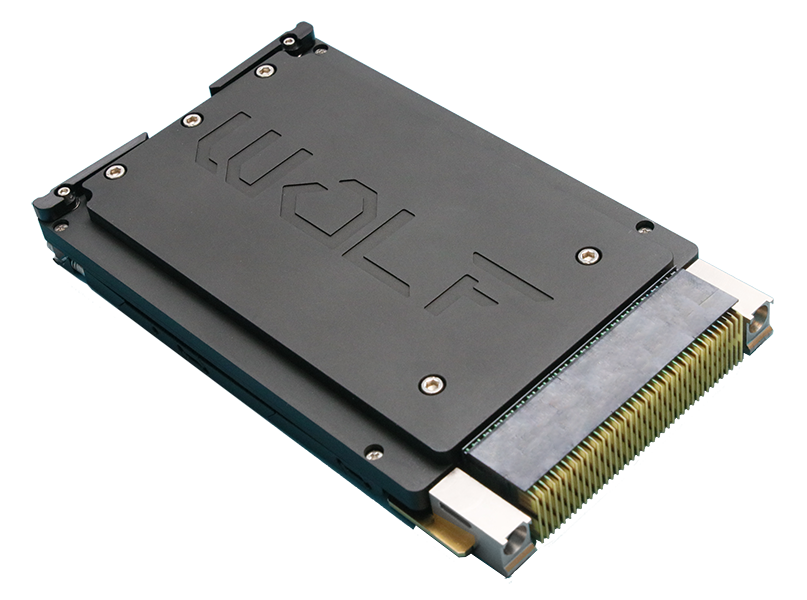
NVIDIA IGX Thor + ConnectX-7 Secure SBC for C5ISR
The VPX3U-THOR-CX7-SBC is a SOSA-aligned 3U VPX single board computer designed for demanding C5ISR applications that require secure compute, high data-transfer rates, and cyber security features for protected mission data.
The module integrates NVIDIA IGX Thor™ (Arm Neoverse-V3AE CPU + Blackwell-class GPU acceleration) with 128 GB ECC LPDDR5X system memory and 1 TB NVMe storage, delivering up to 2070 FP4 TFLOPS for AI workloads such as sensor fusion, machine vision, robotics, and deep-learning inference.
An onboard NVIDIA ConnectX-7® SmartNIC provides high-speed network connectivity and a configurable PCIe switch, including support for RoCE and NVIDIA GPUDirect for low-latency data movement to the GPU.
Features
WOLF-16T5 is a rugged 3U VPX SOSA-aligned secure SBC that combines NVIDIA IGX Thor compute (Arm CPU + Blackwell GPU acceleration) with a ConnectX-7 SmartNIC for high-bandwidth Ethernet and PCIe switching. With 128 GB ECC LPDDR5X memory, 1 TB NVMe storage, RoCE/GPUDirect support, and a configurable 70W to 150W power envelope, it is designed for AI-enabled C5ISR compute nodes that must move large datasets securely and efficiently across the VPX backplane.
Video / AI Features
- Display output: DisplayPort MST / HDMI
- Up to 6× 4Kp60 (H.265) encode
- Up to 10× 4Kp60 (H.265) decode
- Supports NVIDIA Isaac GR00T, Metropolis, and Holoscan (platform support)
Connectivity / System Management
- ConnectX-7 SmartNIC with configurable PCIe switch:
- One x8 port (may bifurcate to x4 + x4), or one x4 + 40/100GBASE-KR4
- Backplane Ethernet: two 10/25GBASE-KR
- 2.5GBASE-T Ethernet with TSN support to P2A
- USB 3.2 and USB 2.0 to P2A
- Optional dual CAN bus to P2A
- Front panel USB-C for setup/debug
- RoCE and NVIDIA GPUDirect support (incl. GPUDirect Storage)
- Advanced IPMC and security management features
Mechanical / Open Systems Architecture
- Rugged conduction cooled
- Operating temperature: -40°C to +70°C standard, operational to +80°C
- Vibration (sine): 10G peak (5–2000 Hz)
- Shock: 40G peak
- Dimensions: 160mm x 100mm x 25.4mm
- Weight (approx.): 1.5 kg
- ANSI/VITA 48, 65 (VPX-REDI, OpenVPX)
- SOSA aligned SBC slot profile: 14.2.16
Specifications
Key configuration and performance parameters for WOLF-16T5 are summarized below for quick comparison. Values shown reflect the standard module configuration; contact WOLF if you need a tailored build or a specific payload profile.
Configuration Guide
This module is preliminary and configuration options (lane mapping, Ethernet mode, safety/security options, and XMC I/O) are application dependent.
Contact Sales for the latest ordering numbers and available options.
Related Products
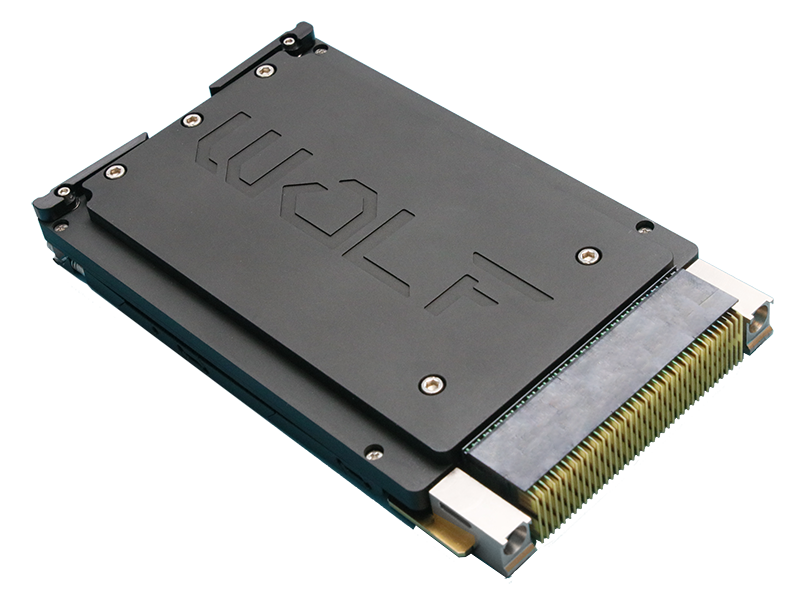
- NVIDIA IGX Thor (T5000) (Arm CPU + Blackwell GPU acceleration)
- 2560 CUDA Cores, 96 Tensor Cores
- 128 GB LPDDR5X VRAM
- PCIe Gen 4, 2x10GbE, 2.5GbE
- SOSA SBC
- Module power 90–150 W
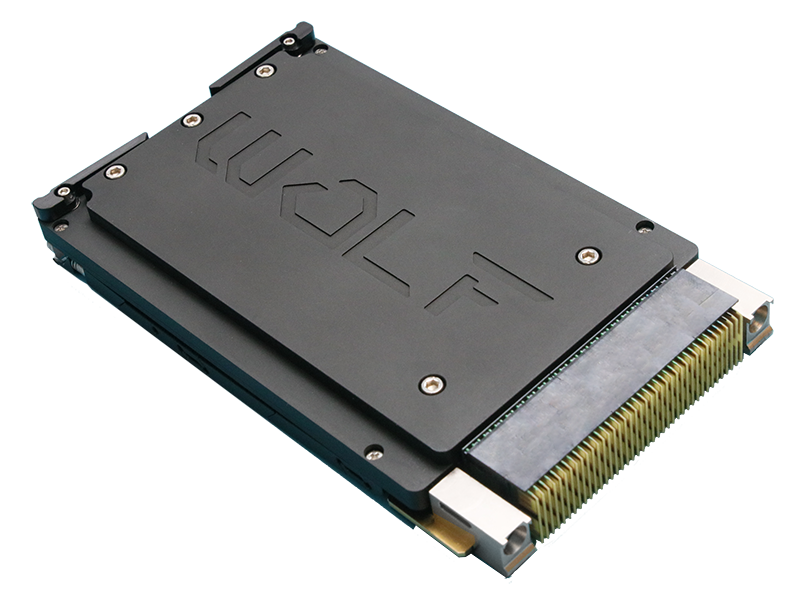
- NVIDIA IGX Thor (T5000) (Arm CPU + Blackwell GPU acceleration)
- 2560 CUDA Cores, 96 Tensor Cores
- 128 GB LPDDR5X VRAM
- PCIe Gen 4, 2x10/25GbE, 2.5GbE TSN
- SOSA SBC
- Module power 70–150 W
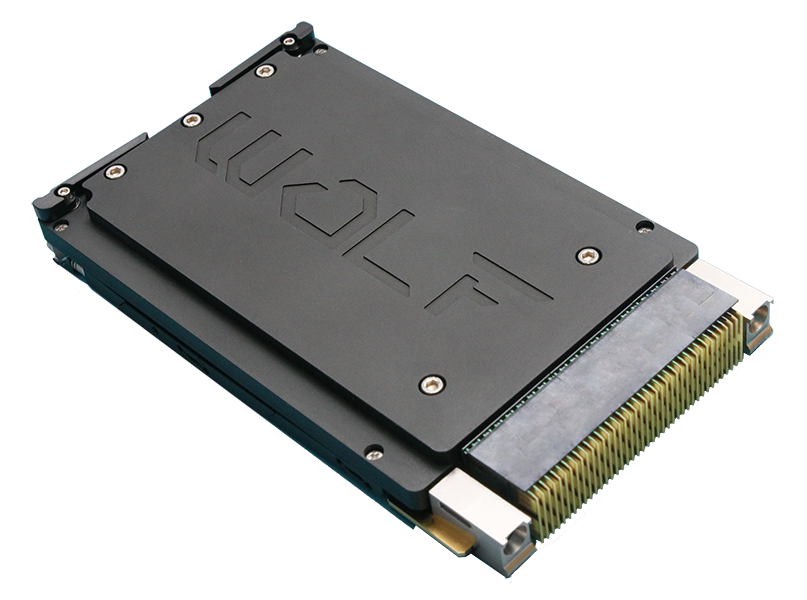
- NVIDIA IGX Thor (T5000) (Arm CPU + Blackwell GPU acceleration)
- 2560 CUDA Cores, 96 Tensor Cores
- 128 GB LPDDR5X VRAM
- 100GbE, PCIe Gen 5, SDI I/O
- SOSA SBC
- Module power 70–150 W
FAQ
Choose WOLF-16T5 when you need Thor in the SBC role (system services, orchestration, platform control) with SmartNIC fabric connectivity.
Choose WOLF-16TZ when you already have an SBC and want Thor as a payload compute node.
A simple rule:
- WOLF-16T5 = Thor as the SBC node
- WOLF-16TZ = Thor as a payload compute node
Confirm these early:
- SBC slot profile: 14.2.16
- Backplane configuration: PCIe Gen4 x4 plus optional 40/100GBASE-KR4, or PCIe Gen4 x8 (may bifurcate) depending on build
- Backplane Ethernet: two 10/25GBASE-KR links
- Display output configuration: DP MST/HDMI routing and rear I/O assumptions
- Management and security features required by your program
Treat it as a system topology decision.
Confirm early:
- Whether you need one x8 path or two x4 paths (if bifurcation is used)
- Which endpoints live behind the switch vs direct-to-CPU/GPU paths
- Whether your chassis PCIe fabric assumptions match the chosen topology
Contact Sales for available lane-mapping and switch configuration options.
The biggest ordering-time choices are typically fabric and topology decisions:
- ConnectX-7 configuration: PCIe Gen4 x8 (may bifurcate) vs PCIe Gen4 x4 + 40/100GBASE-KR4 drives how the module fits the chassis backplane topology
- Ethernet configuration: determines how the 10/25GBASE-KR links are mapped and enabled for the intended fabric role
- Display output configuration: DP MST vs HDMI impacts rear I/O and harness planning
- Power threshold selection: must match chassis thermal capability for sustained performance
Contact Sales for ordering numbers and configuration options.