WOLF-16T9
Block Diagram
The block diagram shows the IGX Thor (T5000) compute complex with 128 GB ECC LPDDR5X and a 1TB NVMe SSD, connected to the VPX backplane via PCIe Gen4 x4 and dual 10GBASE-KR Ethernet through an XFI-PHY. It also highlights DisplayPort output, USB 3.2/USB 2.0, 2.5GBASE-T Ethernet, and IPMI/system-management connectivity.
Overview
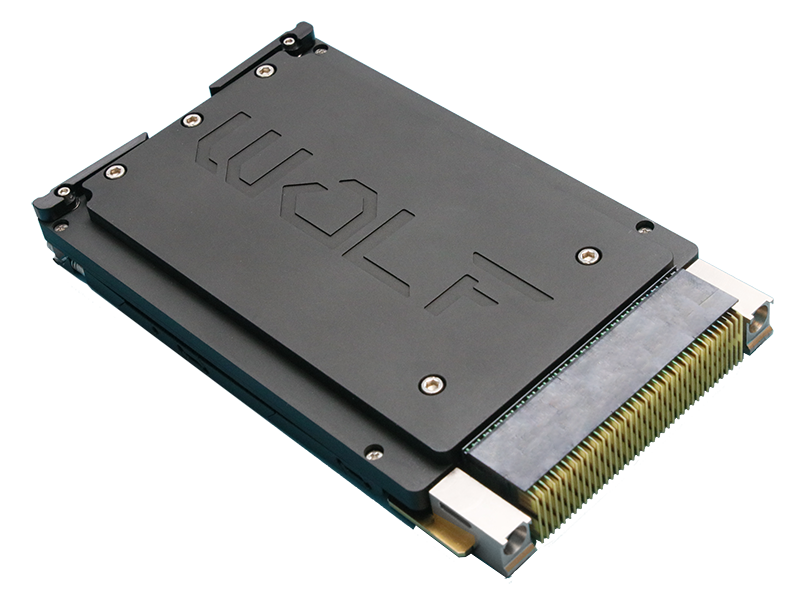
NVIDIA IGX Thor™ Rapid Development SBC
The VPX3U-THOR-RD module provides rapid access to a rugged 3U VPX SBC featuring the NVIDIA IGX Thor™ platform. Designed for demanding C5ISR applications, it delivers advanced AI and HPC processing, high data-transfer rates, and cyber security capabilities for protected mission data.
This SOSA-aligned SBC focuses on easy access to IGX Thor for rapid integration and evaluation, and includes an XFI-PHY for high-bandwidth backplane Ethernet and an onboard 1TB NVMe SSD for storage-dense requirements.
Features
WOLF-16T9 is a rugged 3U VPX SOSA-aligned rapid development SBC built around NVIDIA IGX Thor for embedded AI/HPC. It integrates a 14-core Arm Neoverse-V3AE CPU and Blackwell-class GPU acceleration with 128 GB ECC LPDDR5X memory, an onboard 1TB NVMe SSD, and backplane connectivity that includes PCIe Gen4 x4 and dual 10GbE. Power is configurable from 90W to 150W for platform thermal tuning.
Video / AI Features
- DisplayPort output
- Up to 2070 TFLOPS (FP4, sparse) AI compute
- 2× HEVC (H.265) and AVC (H.264) NVENC and NVDEC, up to 4K-UHD encode resolution
- CUDA 13, OpenGL 4.6, OpenGL ES 3.2, Vulkan 1.2
Connectivity / System Management
- Backplane Ethernet: 2× 10GBASE-KR (via XFI-PHY)
- PCIe Gen4 x4 uplink to VPX backplane
- 2.5GBASE-T Ethernet to P2
- USB 3.2 and USB 2.0 to P2
- DisplayPort to P2
- Front-panel USB-C for setup/debug
- 1TB NVMe storage
- On-board IPMI controller for system management
Mechanical / Open Systems Architecture
- Rugged conduction cooled
- Operating temperature: -40°C to +70°C
- Random vibration: 12grms, 5Hz to 2kHz
- Sine vibration: 10G peak, 5Hz to 2kHz
- Shock: 40G peak
- Dimensions: 160mm x 100mm x 25.4mm
- Weight: TBD
- ANSI/VITA 48/65 (VPX-REDI, OpenVPX)
- SOSA aligned SBC slot profile: 14.2.16
Specifications
Key configuration and performance parameters for WOLF-16T9 are summarized below for quick comparison. Values shown reflect the standard module configuration; contact WOLF if you need a tailored build or a specific payload profile.
Configuration Guide
The following table defines a series of common order codes for the VPX3U-THOR-RD module. The asterisks denote characters of the part number that are defined based on common configuration options.
Common configuration options for this module are default power threshold, variant locked, and conformal coatings.
Contact Sales for the latest ordering numbers and available options.
Representative Ordering Numbers
| Ordering Number | Description |
|---|---|
| 16T933-F***-***VPX3vA0 | 3U VPX, conduction cooled, 1", NVIDIA IGX Thor, PCIe Gen4 x4, 2× 10GBASE-KR, 1× 2.5GBASE-T, 1× DisplayPort output |
Related Products
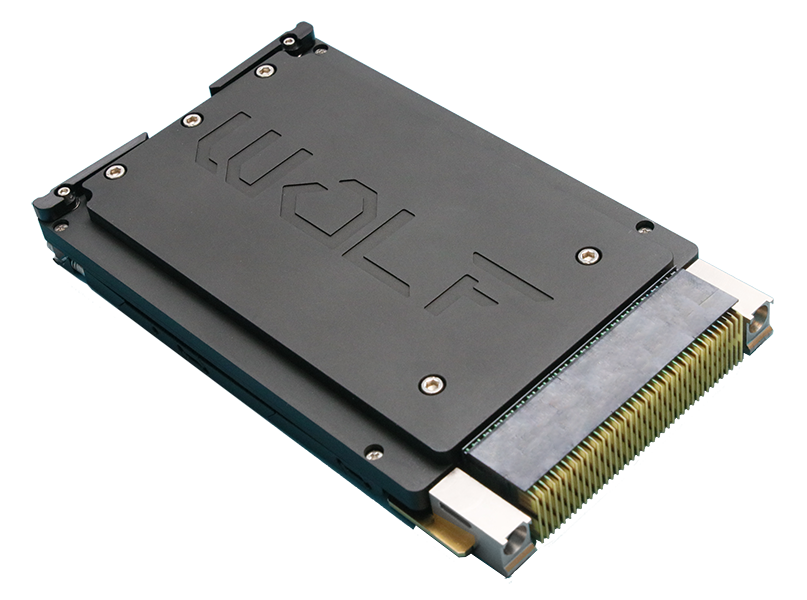
- NVIDIA IGX Thor (T5000) (Arm CPU + Blackwell GPU acceleration)
- 2560 CUDA Cores, 96 Tensor Cores
- 128 GB LPDDR5X VRAM
- 100GbE, PCIe Gen 5, 2.5GbE
- SOSA SBC
- Module power 70–150 W
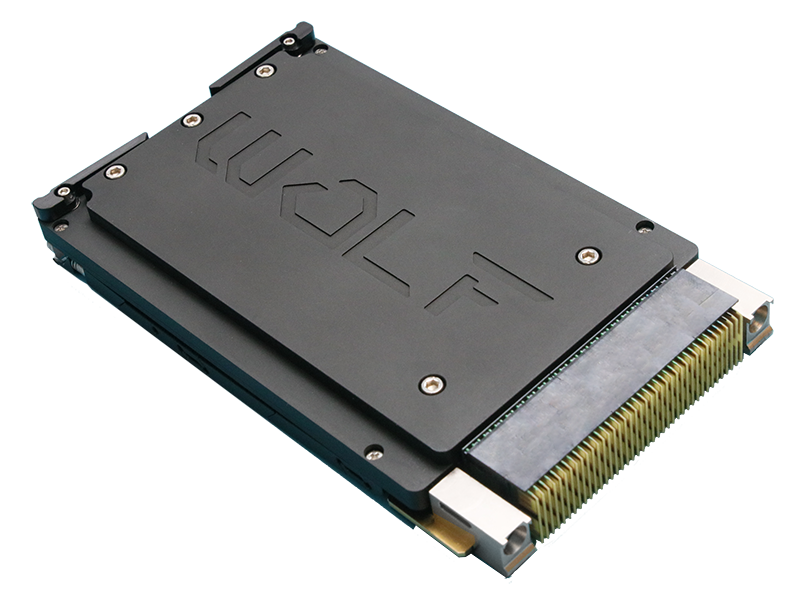
- NVIDIA IGX Thor (T5000) (Arm CPU + Blackwell GPU acceleration)
- 2560 CUDA Cores, 96 Tensor Cores
- 128 GB LPDDR5X VRAM
- PCIe Gen 4, 2x10/25GbE, 2.5GbE TSN
- SOSA SBC
- Module power 70–150 W
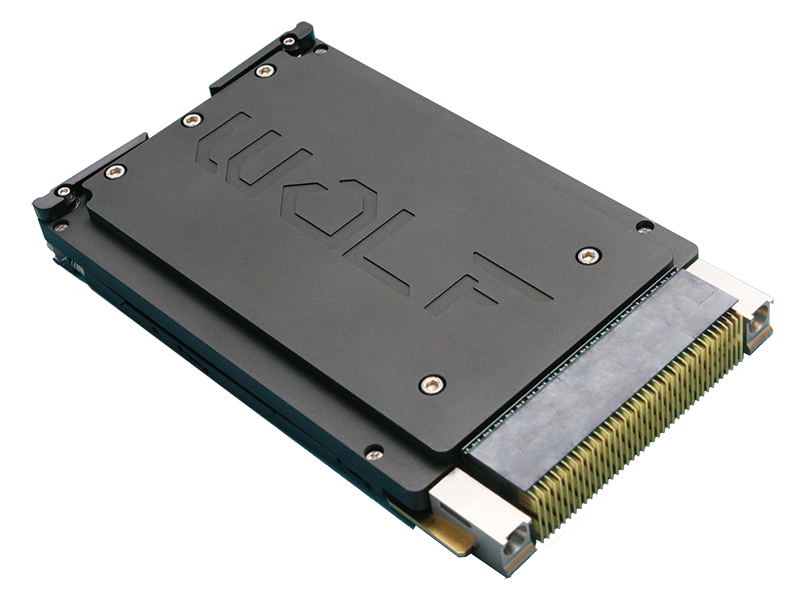
- NVIDIA IGX Thor (T5000) (Arm CPU + Blackwell GPU acceleration)
- 2560 CUDA Cores, 96 Tensor Cores
- 128 GB LPDDR5X VRAM
- 100GbE, PCIe Gen 5
- SOSA Payload
- Module power 70–150 W
FAQ
WOLF-16T9 is a rapid development Thor SBC intended for fast access to Thor in a rugged 3U VPX form factor.
It is typically used for:
- Early software bring-up and pipeline prototyping
- Platform integration trials before locking a final fabric and I/O configuration
- Demonstrations and lab validation using a simplified SBC baseline
Prioritize:
- PCIe Gen4 x4 backplane link stability under sustained load
- Dual backplane 10GBASE-KR Ethernet stability and throughput under real traffic patterns
- Storage integrity and sustained performance on the onboard 1TB NVMe
- DisplayPort output behavior with your intended sinks and EDID constraints
- USB-C setup/debug workflows and IPMI/system management access
Choose the lowest power threshold that still meets your performance targets to protect thermal margin and simplify chassis integration.
Practical guidance:
- Start conservative for lab chassis and early integration
- Increase only after you validate cooling, airflow, and conduction paths
- Treat power as a system-level constraint, not a board-only setting
Contact Sales for available power configuration options.
WOLF-16T9 is typically offered as a rapid development baseline, but the main ordering-time tradeoffs still map to integration fit:
- Lane mapping / backplane configuration: how PCIe Gen4 x4 and dual 10GBASE-KR are presented and mapped to your chassis
- Display output configuration: DisplayPort routing expectations for rear I/O
- Storage and management assumptions: NVMe usage model and IPMI/system-management expectations for your lab or prototype environment
- Power threshold selection: should match the cooling available in the development chassis while preserving headroom for sustained workloads
Contact Sales for ordering numbers and configuration options.