WOLF-163L
Block Diagram
The block diagram illustrates how the NVIDIA RTX 5000 Blackwell GPU and ConnectX-7 SmartNIC are integrated on the 3U VPX module including the PCIe fabric network interfaces and high-speed data paths used to move sensor and mission data efficiently through the system.
Overview
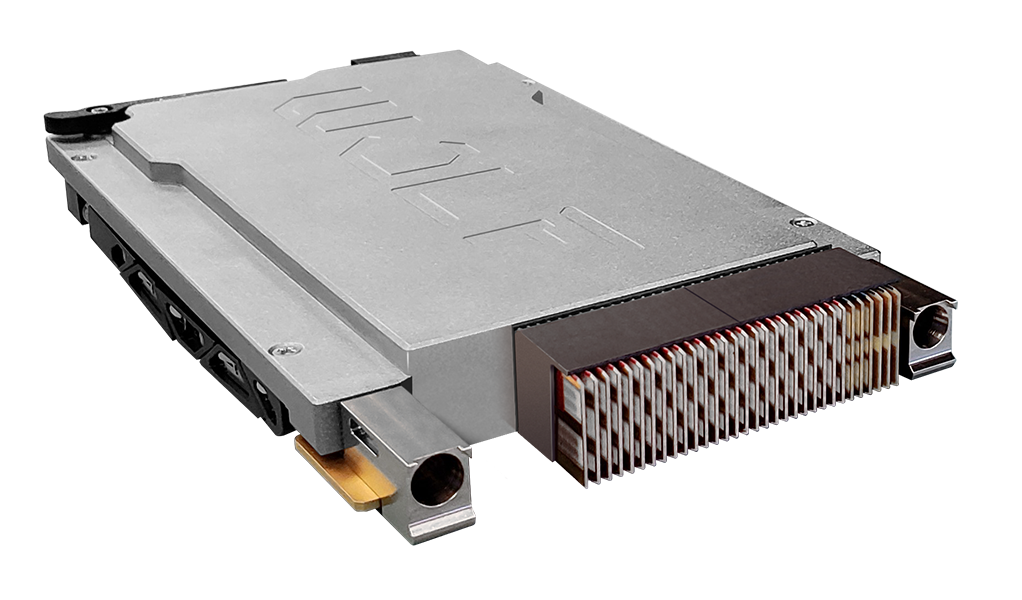
HPEC with NVIDIA Blackwell GPU and ConnectX-7
The VPX3U-BW5000E-CX7 HPEC module includes an NVIDIA RTX 5000 Blackwell embedded GPU and a ConnectX SmartNIC. The NVIDIA RTX 5000 Blackwell embedded GPU provides the advanced processing capabilities for high performance embedded computing (HPC) and artificial intelligence (AI) processing. The ConnectX-7 provides the Ethernet and PCIe connectivity needed to move large datasets efficiently.
The module also supports 24GB of GDDR7 memory which provides over 50% higher bandwidth compared to the previous generation. This HPEC module integrates two high performance elements; NVIDIA RTX 5000 Blackwell embedded GPU and NVIDIA ConnectX-7 SmartNIC
The NVIDIA ConnectX-7 SmartNIC provides PCIe and Ethernet connectivity. ConnectX-7 is ideal for the high-speed, secure, data transfer capabilities required for data-heavy tasks such as sensor data processing and other C5ISR tasks. The ConnectX-7 also provides support for RDMA over Converged Ethernet (RoCE), enabling the fastest method for transferring data across the network to the GPU.
Features
WOLF-163L is a rugged 3U VPX HPEC module that integrates an NVIDIA RTX 5000 Blackwell GPU with an NVIDIA ConnectX-7 SmartNIC. It combines up to 100GbE Ethernet with a configurable PCIe switch to move large datasets efficiently across the VPX backplane. The onboard 24 GB GDDR7 memory with ECC support and configurable 80W to 120W power envelope enable bandwidth-intensive AI and HPC pipelines in harsh -40°C to +85°C deployed environments.
GPU Features
- Blackwell GPU parallel processing:
- 10496 CUDA Cores, 320 Tensor Cores
- 24 GB GDDR7 256-bit VRAM with ECC support
- CUDA Toolkit 13, CUDA Compute capability 12.0
- OpenCL 3.0, DirectX 12 Ultimate, OpenGL 4.6, OpenGL ES 3.2, Vulkan 1.2
- 5th Gen Tensor Cores with new data precisions (new: FP4 and FP6, FP8 Gen2)
- NVENC (9th Gen) and NVDEC (6th Gen) with up to 8K video encoding and hardware decoding support
Connectivity / System Management
- On-board IPMI controller for system management
- PCIe configurable switch
- Switching is offloaded from the CPU to the ConnectX with NVIDIA ASAP2 technology
- Support for 40/100GBASE-KR4 protocols
- 10/25GBASE-KR Data and Control planes
- GPUDirect RDMA and RoCE support
- Block-level hardware encryption and the use of dedicated encryption keys per user
- Linux and Windows drivers
Mechanical / Open Systems Architecture
- High level of ruggedization:
- Rugged conduction cooled
- Operating temperature: -40°C to +70°C standard, operational to +85°C
- Vibration Random: VITA 47.1 Class V3 (5 to 2000Hz)
- Vibration Sine: 10g peak (5 to 2000 Hz)
- Shock: 40G (MIL-STD-810H, Method 516.8)
- Dimensions: 160mm x 100mm x 25.4mm
- Weight (approximately): 1.3 kg
- SOSA Aligned slot profile: 14.6.11-0 or 14.6.13-0
- Option to populate 2B for video output
Specifications
Key configuration and performance parameters for WOLF-163L are summarized below for quick comparison. Values shown reflect the standard module configuration; contact WOLF if you need a tailored build or a specific payload profile.
Configuration Guide
The table below provides representative ordering codes for the VPX3U-BW5000E-CX7 family. Asterisks (*) indicate configurable options such as lane mapping, Ethernet configuration, payload slot profile selection, variant locking, default power threshold, and conformal coating.
Contact Sales for the latest ordering numbers and available options.
Representative ordering numbers
| Ordering Number | Description |
|---|---|
| 163L33-F***-***VPX3vA0 | 3U VPX, Conduction Cooled, 1", 14.6.11 payload profile, NVIDIA Blackwell RTX 5000, ConnectX-7 SmartNIC, PCIe P1 x16 and P2 x4, Network dual ports each 50GbE |
| 163L33-F***-***VPX3vA0 | 3U VPX, Conduction Cooled, 1", 14.6.13 payload profile, NVIDIA Blackwell RTX 5000, ConnectX-7 SmartNIC, PCIe P1 x16 and P2 x4, Network dual ports each 50GbE |
Related Products
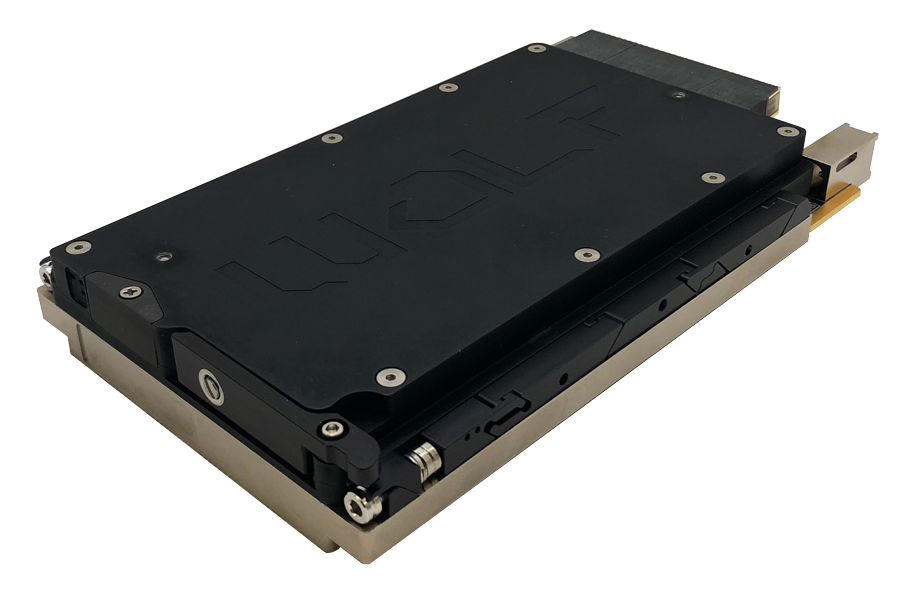
- NVIDIA RTX 5000 Blackwell (GB203)
- 10496 CUDA Cores, 320 Tensor Cores
- 24 GB GDDR7 VRAM
- PCIe Gen 4
- SOSA Payload, OpenVPX
- Module power 90–150 W
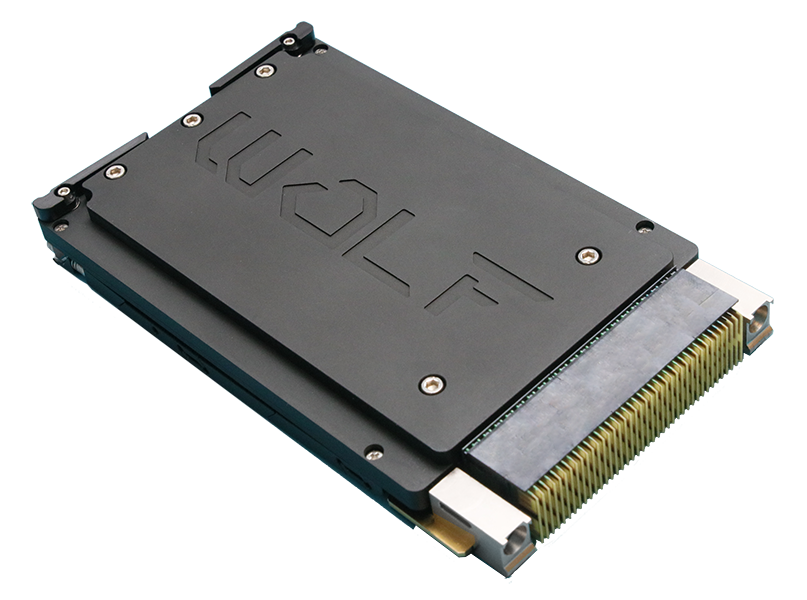
- NVIDIA RTX 5000 Blackwell (GB203)
- 10496 CUDA Cores, 320 Tensor Cores
- 24 GB GDDR7 VRAM
- 200GbE, PCIe Gen 4
- SOSA Switch
- Module power 100–180 W
FAQ
Choose WOLF-163L when your system needs to move large datasets on/off the module with minimal CPU involvement—for example, high-rate sensor ingest, distributed processing across multiple compute nodes, or multi-host pipelines.
The key differentiator is the ConnectX-7 SmartNIC combined with RoCE and GPUDirect RDMA, which are intended to reduce CPU copies and latency when feeding the GPU.
If your workload is primarily GPU compute inside a single chassis with modest I/O, a GPU-only module may be simpler; if your bottleneck is data movement, the SmartNIC is typically the value driver.
It enables high-speed network data to land closer to where the GPU can use it, reducing extra staging through host memory and reducing CPU overhead.
This matters most when you have:
- Large streaming datasets (radar, EO/IR, signals)
- Multi-node systems where data must traverse an Ethernet fabric efficiently
- Tight latency budgets where CPU interrupts/copies become limiting
WOLF-163L also supports switching offload features (e.g., ASAP2) to keep the host CPU focused on mission applications rather than packet movement.
Confirm these items early to avoid late-stage backplane surprises:
- Slot profile alignment: SOSA 14.6.11-0 (P2 depopulated) or 14.6.13-0 (P2B depopulated)
- PCIe fabric availability: common builds use PCIe P1 x16 + P2 x4—confirm lane routing and generation match your chassis/backplane
- Ethernet electrical interface support: 40/100GBASE-KR4 plus 10/25GBASE-KR data/control planes—confirm plane mapping and backplane support
- Optional rear video: if you intend to use optional DisplayPort on P2B, confirm P2B routing is present in the selected profile and chassis
The most important choices are typically system-integration tradeoffs:
- Payload slot profile (14.6.11 vs 14.6.13): drives backplane compatibility and whether P2B resources (like optional rear DP) are relevant
- PCIe + Ethernet configuration: determines lane/port presentation and influences throughput and how you architect the data path
- Default power threshold (80W–120W envelope): should match chassis cooling capability for sustained performance
- Ruggedization/configuration control: options like conformal coating and variant locking support deployed programs with strict configuration control
The module also includes on-board IPMI plus block-level hardware encryption with per-user keys, which can matter for platform management and data-at-rest requirements.
Contact Sales for the latest ordering numbers and available configuration options.