WOLF-163S
Block Diagram
The block diagram illustrates the integrated NVIDIA RTX 5000 Blackwell GPU, PCIe Gen4 switch, and 200GbE Ethernet switch combined on one 3U VPX switch module. It highlights the PCIe fan-out paths that feed the GPU and uplink to the VPX backplane, alongside the high-bandwidth Ethernet fabric routes used to move sensor and mission data through the chassis.
Overview
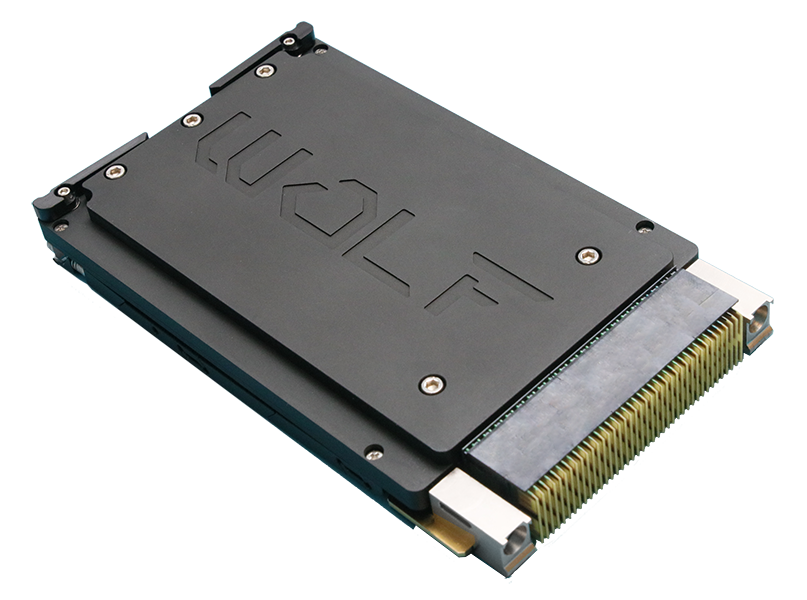
System Switch + HPC in One 3U Slot
The VPX3U-BW5000E-SWITCH rugged 3U VPX module includes an NVIDIA RTX 5000 Blackwell embedded GPU, a PCIe Gen4 switch, and a 200 GbE network switch in a single slot-saving module. It can operate as both the system fabric switch and a high performance compute node, freeing chassis space for other payloads.
This slot-saving module merges three high performance elements; NVIDIA RTX 5000 Blackwell embedded GPU (10496 CUDA / 320 Tensor), Configurable PCIe Gen4 switch and a 200 GbE network switch (up to 8 × 25GbE + 1 × 1GbE) for flexible high-bandwidth Ethernet routing within the VPX chassis.
The NVIDIA Blackwell GPU architecture provides increased efficiency and 24GB of GDDR7 memory, delivering over 50% higher bandwidth compared to the previous generation.
WOLF's advanced cooling technology is designed to move heat efficiently from the hot devices to the wedgelocks, enabling sustained deterministic performance in harsh aerospace and defense environments.
Features
WOLF-163S is a rugged 3U VPX module designed for embedded AI and HPEC workloads. Powered by NVIDIA RTX 5000 Blackwell, it pairs high-throughput 200GbE and PCIe Gen4 connectivity with a SOSA/OpenVPX-aligned mechanical profile (SOSA Switch 14.4.15). The onboard 24 GB GDDR7 memory helps sustain bandwidth-intensive pipelines, while the integrated feature set supports deterministic performance across harsh -40°C to +85°C environments.
GPU Features
- Blackwell GPU parallel processing:
- 10496 CUDA Cores, 320 Tensor Cores
- 24 GB GDDR7 256-bit VRAM with ECC support
- CUDA Toolkit 12, Compute capability 10.0
- OpenCL 3.0, DirectX 12 Ultimate, OpenGL 4.6, OpenGL ES 3.2, Vulkan 1.2
- 5th Gen Tensor Cores with new data precisions (FP4 and FP6, FP8 Gen2)
- GDDR7 memory provides over 50% more bandwidth compared to the previous generation
- NVENC (9th Gen) and NVDEC (6th Gen) with up to 8K video encoding and hardware decoding support
Connectivity / System Management
- Configurable PCIe Gen4 switch
- Configurable 200 GbE network switch: 8 ports up to 25GbE and one 1000BASE-T
- Time-Sensitive Networking (TSN) supported
- NVIDIA GPUDirect RDMA support
- IPMI system management
- Linux and Windows drivers
Mechanical / Open Systems Architecture
- High level of ruggedization:
- Rugged conduction cooled +
- Operating temp: CC: - 40°C to +70°C standard, operational to +85°C
- Vibration Random: VITA 47.1 Class V3 (5 to 2000Hz)
- Vibration Sine: 10g peak (5 to 2000 Hz)
- Shock: 40G (MIL- STD- 810H, Method 516.8)
- Dimensions: 160mm x 100mm x 25.4mm
- Weight (approximately): 1.6kg
- ANSI/VITA 48, 65 (VPX- REDI, OpenVPX)
- SOSA aligned switch slot profile: 14.4.15
Specifications
Key configuration and performance parameters for WOLF-163S are summarized below for quick comparison. Values shown reflect the standard module configuration; contact WOLF if you need a tailored build or a specific payload profile.
Configuration Guide
The following table defines a series of common order codes for the VPX3U-BW5000E-SWITCH module. The asterisks denote characters of the part number that are defined based on common configuration options.
Some configuration options for this module include:
- Network config options
- PCIe config options
- Variant locked
- Default power threshold
- Conformal coatings
Contact Sales for the latest Ordering Numbers and available options.
Representative ordering numbers
| Ordering Number | Description |
|---|---|
| 163S33-F***-***VPX3vA0 | 3U VPX, Conduction Cooled, 1", 14.4.15 switch profile, NVIDIA Blackwell RTX 5000, 24GB GDDR7, PCIe P1 x16 and P2 x8, Network 8 ports each 25GbE |
| 163S33-F***-***VPX3vA0 | 3U VPX, Conduction Cooled, 1", 14.4.15 switch profile, NVIDIA Blackwell RTX 5000, 24GB GDDR7, PCIe P1 x16 and P2 x4 + x4, Network 8 ports each 10GbE |
Related Products
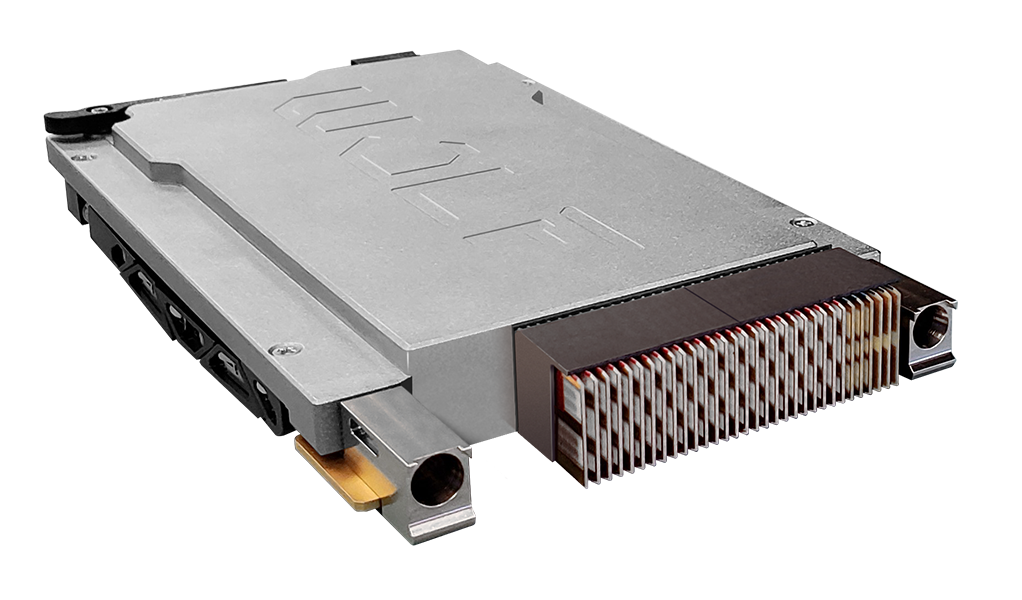
- NVIDIA RTX 5000 Blackwell (GB203)
- 10496 CUDA Cores, 320 Tensor Cores
- 24 GB GDDR7 VRAM
- 100GbE, PCIe Gen 4
- SOSA Payload, OpenVPX
- Module power 80–120 W
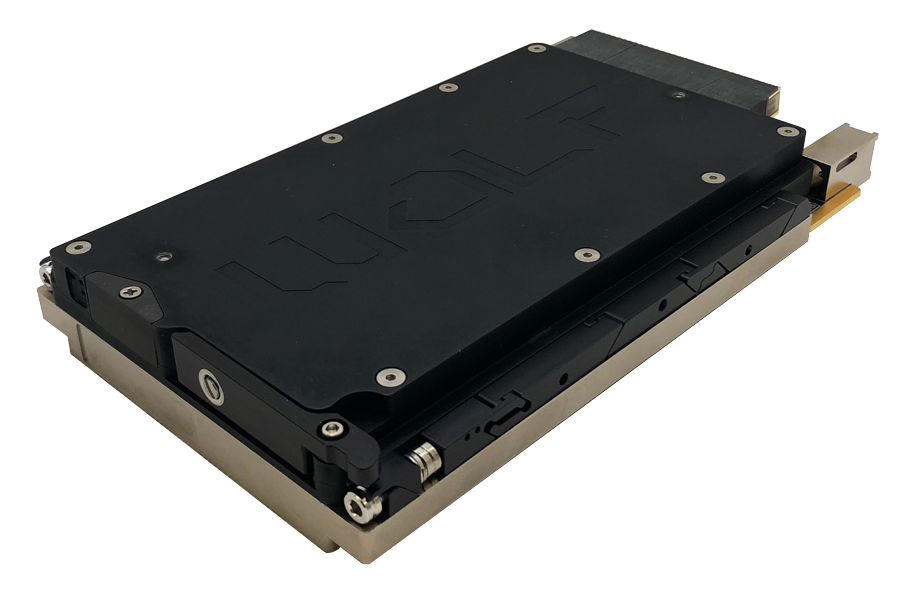
- NVIDIA RTX 5000 Blackwell (GB203)
- 10496 CUDA Cores, 320 Tensor Cores
- 24 GB GDDR7 VRAM
- PCIe Gen 4
- SOSA Payload, OpenVPX
- Module power 90–150 W
FAQ
Choose WOLF-163S when chassis slot budget is tight and you want to combine system fabric switching and GPU compute in a single 3U VPX slot.
This is most useful when:
- The chassis would otherwise need a dedicated Ethernet switch slot plus a separate GPU compute slot
- You want a compute node that can also serve as a fabric aggregation point for sensor/mission data
- You are building a modular VPX system where the switch role may need to scale with compute
If you have ample slots or want to physically separate switch and compute for fault containment or upgrade cadence, discrete modules can be the better program-level choice.
The integrated Ethernet switch is intended for high-bandwidth, flexible fabric routing within the VPX system.
Typical planning considerations:
- Port budgeting: common configurations support up to 8 ports at up to 25GbE plus a 1GbE management-style port (implementation/config dependent).
- Traffic separation: decide early how you will separate payload data, control/management, and any timing flows.
- Determinism features: TSN support can matter when your platform requires bounded latency or time-aware scheduling.
Net: treat WOLF-163S as both a compute resource and a fabric resource, and plan port allocation like you would for a standalone VPX switch module.
Confirm these items early to avoid backplane surprises:
- Switch slot profile alignment: SOSA-aligned 14.4.15 (this is a switch profile, not a payload compute profile).
- PCIe fabric expectations: an onboard PCIe Gen4 switch is present; confirm how you want PCIe fan-out to feed the GPU and other endpoints.
- Ethernet fabric mapping: confirm how 25GbE lanes map to backplane planes and whether your chassis wiring matches the intended topology.
- System management approach: plan for IPMI integration (monitoring, thresholds, inventory) like you would for a managed switch card.
This module is easiest to integrate when the chassis/backplane was already designed with a switch slot role in mind.
The key tradeoffs are usually about fabric behavior rather than raw GPU compute:
- Network configuration: determines port speed/port count presentation and how you partition traffic.
- PCIe switch configuration: affects how PCIe lanes are allocated between the GPU, uplinks, and peer endpoints.
- Power threshold (100W-180W envelope): must match chassis thermal headroom for sustained compute while switching at high throughput.
- Program control options: variant locking and conformal coatings can matter for deployed programs and configuration control.
Contact Sales for the latest ordering numbers and available configuration options.