WOLF-1636
Block Diagram
The block diagram shows a single NVIDIA RTX 5000 Blackwell GPU integrated on the 3U VPX module with a direct PCIe uplink to the VPX backplane (x8 or x16, platform/profile dependent). It highlights the primary high-speed path used to move host/peer data to and from the GPU, and the GPU display routing to the removable front panel DisplayPort connectors, and three DisplayPort links to the rear backplane via the selected OpenVPX profile.
Overview
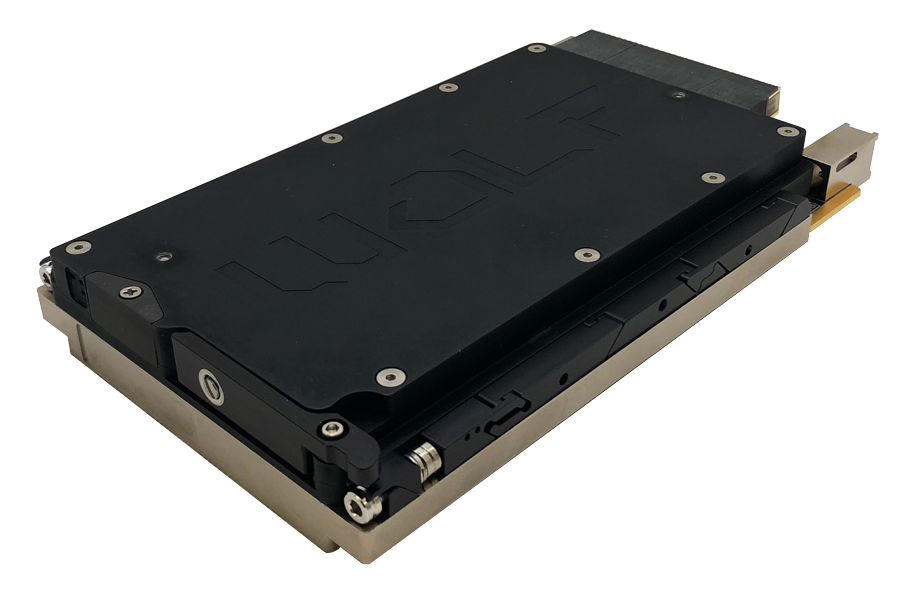
NVIDIA Blackwell RTX 5000 HPC in Rugged 3U VPX
The VPX3U-BW5000E-VO-HPC module is powered by an NVIDIA RTX 5000 Blackwell embedded GPU in a rugged WOLF 3U VPX form factor, delivering the processing needed for high performance embedded computing (HPC) and artificial intelligence (AI) workloads. A removable front panel exposes DisplayPort outputs on the front of the module, and it can be configured with an OpenVPX profile that routes two DisplayPort outputs to the rear backplane.
The NVIDIA Blackwell architecture combines CUDA cores for parallel HPC processing with 5th generation Tensor Cores for AI and data science. Its 24 GB of GDDR7 memory provides over 50% more bandwidth than the previous generation, while PCIe x8 or x16 connectivity offers a high-throughput data path to and from the GPU.
Features
WOLF-1636 is a rugged 3U VPX module that brings NVIDIA RTX 5000 Blackwell processing to embedded HPC and AI applications while providing integrated video outputs for mission visualization. The module supports 24 GB of GDDR7 memory and can be configured for PCIe x8 or PCIe x16 backplane connectivity, with a configurable module power range from 90W to 150W. DisplayPort outputs are exposed on the front panel under a removable cover, and OpenVPX configurations can provide three additional DisplayPort outputs on the rear connector with an HDMI option for rear outputs.
GPU Features
- Blackwell GPU parallel processing:
- 10496 CUDA Cores, 320 Tensor Cores
- 24 GB GDDR7 256-bit VRAM with ECC support
- CUDA Toolkit 13, Compute capability 12.0
- CUDA-X AI and CUDA-X HPEC libraries
- OpenCL 3.0, DirectX 12 Ultimate, OpenGL 4.6, OpenGL ES 3.2, Vulkan 1.2
- 5th Gen Tensor Cores with additional new data precisions (new: FP4 and FP6, FP8 Gen2)
- GDDR7 memory provides over 50% more bandwidth compared to the previous generation
- NVENC (9th Gen) and NVDEC (6th Gen) with up to 8K video encoding and hardware decoding support
Connectivity / System Management
- PCIe x8 and x16 profiles
- IPMI system management
- NVIDIA GPUDirect RDMA support
- Linux and Windows drivers
Mechanical / Open Systems Architecture
- High level of ruggedization:
- Rugged conduction cooled
- Operating temp: CC: - 40°C to +70°C standard, operational to +85°C
- Vibration Random: VITA 47.1 Class V3 (5 to 2000Hz)
- Vibration Sine: 10g peak (5 to 2000 Hz)
- Shock: 40G (MIL- STD- 810H, Method 516.8)
- Dimensions: 160mm x 100mm x 25.4mm
- Weight (approximately): 1.3 kg
- ANSI/VITA 48, 65 (VPX- REDI, OpenVPX)
- SOSA Aligned profile support: 14.6.11- 0, 14.6.13- 0, or OpenVPX 14.2.7
Specifications
Key configuration and performance parameters for WOLF-1636 are summarized below for quick comparison. Values shown reflect the standard module configuration; contact WOLF if you need a tailored build or a specific payload profile.
Configuration Guide
The following table defines series of common order codes for the VPX3U-BW5000E-VO-HPC module. The asterisks denote characters of the part number that are defined based on common configuration options.
Some configuration options for this module include:
- SOSA or OpenVPX profiles
- Display Interfaces
- Variant Locked
- Default Power Threshold
- Conformal Coatings
Contact Sales for the latest Ordering Numbers and available options.
Representative ordering numbers
| Ordering Number | Description |
|---|---|
| 163633-F***-***VPX3vA0 | 3U VPX, Conduction Cooled, 1", 14.6.11 payload profile, NVIDIA Blackwell RTX 5000, PCIe P1 x16 and P2 x4, Display Outputs 4 x DP |
| 163633-F***-***VPX3vA0 | 3U VPX, Conduction Cooled, 1", 14.6.11 payload profile, NVIDIA Blackwell RTX 5000, PCIe P1 x16 and P2 x8, Display Outputs 2 x DP |
Related Products
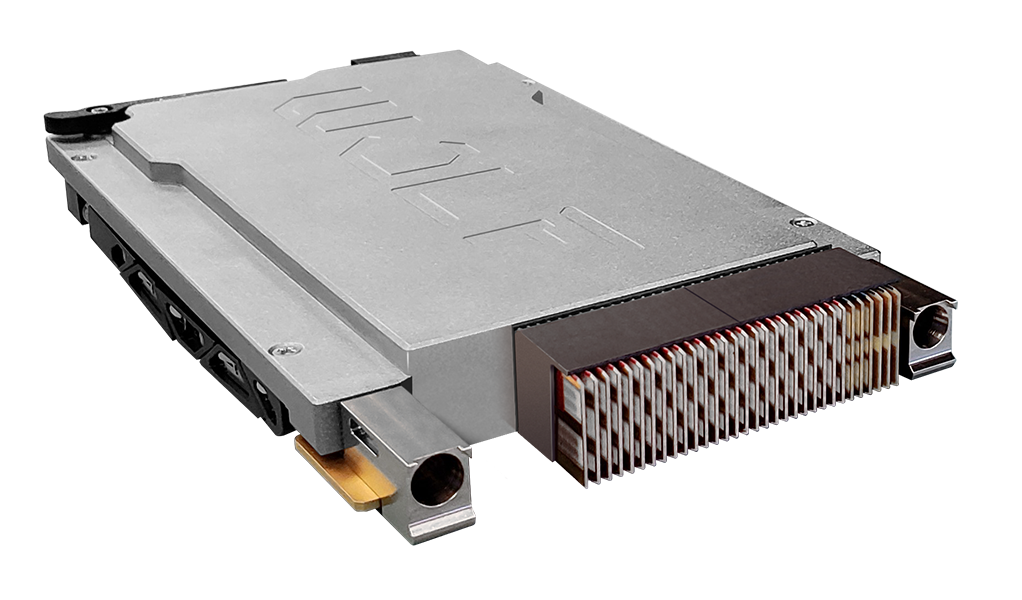
- NVIDIA RTX 5000 Blackwell (GB203)
- 10496 CUDA Cores, 320 Tensor Cores
- 24 GB GDDR7 VRAM
- 100GbE, PCIe Gen 4
- SOSA Payload, OpenVPX
- Module power 80–120 W
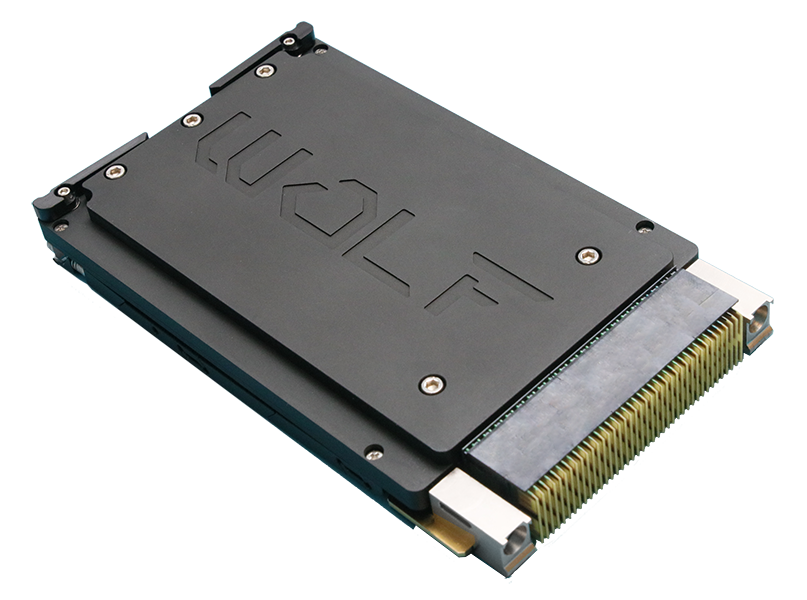
- NVIDIA RTX 5000 Blackwell (GB203)
- 10496 CUDA Cores, 320 Tensor Cores
- 24 GB GDDR7 VRAM
- 200GbE, PCIe Gen 4
- SOSA Switch
- Module power 100–180 W
FAQ
Choose WOLF-1636 when your primary need is GPU compute plus mission visualization (DisplayPort routed to the front panel and/or rear backplane), and your system does not require an integrated SmartNIC.
This module is typically a strong fit for:
- In-chassis AI/HPC + operator display workflows
- Systems where video routing (front/rear DP) matters as much as raw compute
- Architectures where networking is handled elsewhere (switch card, separate NIC, or SBC)
If your bottleneck is moving large datasets over the VPX fabric (e.g., high-rate sensor ingest over Ethernet with RDMA), a GPU + SmartNIC module is usually the better architectural choice.
WOLF-1636 supports multiple display routing strategies depending on the build:
- Front panel: a removable front panel exposes DisplayPort outputs for direct access during integration, lab use, or operator display use.
- Rear backplane (profile dependent): configurations can route DisplayPort links to the rear connector (OpenVPX profile dependent), and some builds include HDMI option for rear outputs.
Integration guidance:
- Decide early whether you need front-access DP, rear-routed DP, or both.
- Align the selection with your slot profile and chassis rear I/O expectations to avoid late backplane changes.
Confirm these early to avoid profile mismatches and stranded I/O:
- Slot profile support: SOSA-aligned 14.6.11-0, 14.6.13-0, or OpenVPX 14.2.7 (profile choice impacts what is routed to rear connectors).
- PCIe uplink expectation: configurations support PCIe x8 or x16 (platform/profile dependent). Confirm lane routing and whether your system expects x8 vs x16.
- Display routing assumptions: if you need rear DP, confirm the chosen profile actually routes the desired display links.
In practice, treating the slot profile selection as an I/O routing decision (not just mechanical compliance) prevents integration churn.
The most impactful options tend to be the ones that change system integration behavior:
- SOSA vs OpenVPX profile: drives backplane routing, including whether/how displays are routed to the rear connector.
- Display interface configuration: front-panel DP vs rear DP (and whether HDMI is needed on rear outputs).
- PCIe width selection (x8 vs x16): impacts host-to-GPU transfer headroom and how you architect peer traffic.
- Power threshold selection (90W-150W envelope): should match chassis thermal capability for sustained performance.
Contact Sales for the latest ordering numbers and available configuration options.